

by Peter Niehoff
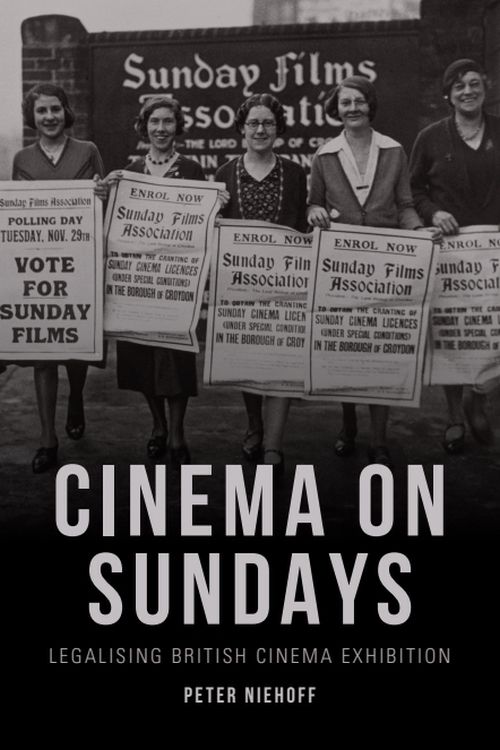
Recounts the emergence of legal Sunday cinema culture in Great Britain
No laughter in cinemas
During the Second World War, when it became ever more apparent that officers and soldiers required expanded Sunday cinemagoing to buttress morale, many places that had previously resisted opening begrudgingly acquiesced. But, in doing so, they stipulated a high threshold to obtain a licence. Probably the most unique one was devised by authorities in Northampton.
In late 1940, the Northampton Mercury reported, ‘No Laughter in Sunday Cinemas.’ How of course, could a condition such as this be implemented or even enforced? The article relayed that if local cinema managers wanted to open, they could not schedule comedy films on Sundays. This condition reflected a desire, in the face of drastic change, to maintain some semblance of the traditional English Sunday. By showing only uplifting and morally centered content, the spiritual sanctity of the Lord’s Day would be maintained they believed. A similar desire seeped into many Sunday licences across the country.
Special Sunday films had to be shown
Egham’s Sunday Defence Council was surprised to find ‘in most places where Sunday opening has been obtained the films shown on Sunday are the same as those shown on weekdays.’ Often officials did not elaborate on what exactly they wanted shown, but it is not hard to guess. In a similar vein to Northampton, officials in both Wymondham and Halstead requested that cinemas show appropriate films on Sundays. ‘Only those films suitable for the Lord’s Day be shown,’ Wymondham Councillors instructed. Such strict conditions not only dictated how people watched films but how they came to understand the weekly rhythms of leisure and work, especially when Sunday was the one day most people were “free” from work.
Similarly, in Halstead it was essential ‘That all films shown on Sundays … shall be of a definitely uplifting or religious character and that anything which is contrary to this principle shall be omitted on Sundays.’ The idea that film content could be controlled and moulded to keep the day ‘special’ was due to the belief that people looked for moral messages on Sundays. These begrudging conditions implied that cinemagoing and certain films themselves were amoral, no matter what day it was. Such a stance was designed to nullify the emergent idea secular rest, something that many assumed cinemagoing naturally embodied.
Managers had to offer their theatres for religious service
As the debate over Sunday cinema access spread, many in the opposition felt that cinemagoing was a secularizing force that must be stopped at any price. Wymondham Councillors believed they could stem the tide if they stipulated ‘That the cinema be made available for a religious service one Sunday in every three months,’ if the ministers desired.
Cinemas and churches are very similar spaces. Both organize people into audiences in neat rows. Both spaces also provide messages and community. But also, at the turn of the twentieth century, many churches were converted into cinemas because all that was needed was a screen and projector before sound. While it is not known if Wymondham cinemas were ever actually used for religious services, many evangelical travelling cinema vans toured the countryside every week to places that lacked cinematic accommodations. Additionally, there were also religious and Catholic film societies that both produced and screened their own uplifting films.
Intermission for worship
Methodists in Doncaster proposed a required interval during each show for a ten-minute act of worship. Unlike the provision of religious services, this condition would have required the projectionist to pause the film in the middle of the show for a miniature act of worship on Sundays. The sources are silent on important factors of exactly how this would work and what exactly should be put in this mini service. But the Doncaster Methodists never had to worry any further about it because the area never received wartime Sunday cinema powers. While this condition never went into effect, and it was certainly one of the more extreme ideas, the desire for such a stipulation underscored how people saw the imposition of cinemagoing into the culture surrounding the English Sunday. For many, cinema was an intrusion into the spiritual life of the country, and they believed that there should be one day per week that was not commercialised.
What all of these conditions spoke to was maintaining local government autonomy within a very controversial national debate. Legalising Sunday cinema would not have been successful without the close working relationship between local government officials and the bureaucrats in Westminster.
Permission for girlfriends
When the war broke out, the debate over Sunday cinema that many had thought was settled by the 1932 Sunday Entertainments Act, was reignited. Many politicians and chaplains, who had previously rejected any sort of Sunday opening, relented that Sunday cinemagoing would be a nice amenity for the military. It was definitely better than the pub or hanging out in the street. But, they only relented if this was a privilege strictly for soldiers. Very quickly however, many people not just men, but thousands of women were relocated to munitions factories; evacuees and children left London; and refugees all needed somewhere to go. The question quickly became who would not benefit from Sunday cinema.
In the chaos of war, many local cinemas were allowed to sell tickets to anyone. Others restricted family members, children, or other friends. But Sheffield officials had another idea. If soldiers stationed nearby wanted to bring their girlfriend, they had to get permission from their officers to do so and provide her name. This was specifically designed so that they did not take male friends. This policy did not last long because the Central Picture House burned after a Luftwaffe raid in mid-December 1940.
About the author
Peter Niehoff, PhD, is an Adjunct Professor of film and media studies at the University of Cincinnati.