

by Reece Goodall
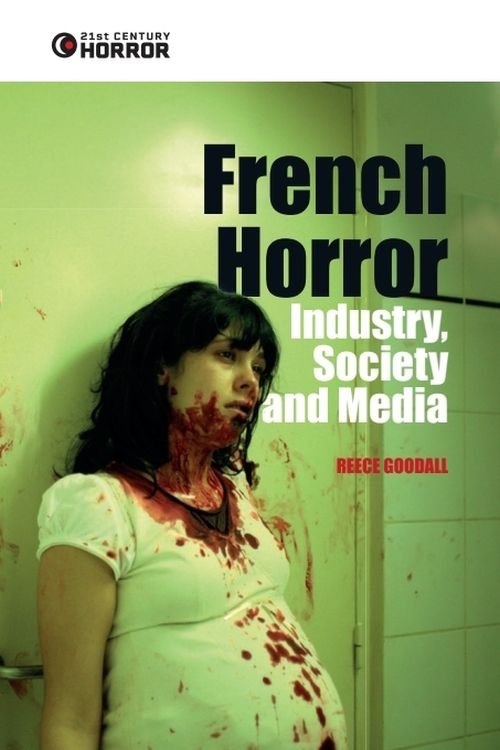
One of the first major works on French horror cinema as an industrial and theoretical entity
Tell us about your book.
French Horror explores the nation’s horror media, examining whether there are specific formal or ideological qualities that mark this horror as identifiably French. The book examines this through three main areas – looking at French horror’s engagement with the national past, exploring the works of key creative figures, and analysing how French horror engages with significant political crises. This leads onto wider questions about what national media even means in a world of streaming media and increasingly closer ties between nations and institutions, and whether we might think about French horror as a post-national construct.
What inspired you to research this area?
I’m a horror fan, and I remember watching the films of the New French Extremity on the Horror Channel late at night. When I came to university to study French, it seemed appropriate that I should combine my interests and explore the genre – and I found surprisingly little scholarship out there already (more has come in the past 10 years, kicked off by Alexandra West’s book on the New French Extremity). In our library, we’ve got books on pretty much every nation’s horror except France – I couldn’t believe that the holistic book on French horror wasn’t there, so I decided to write it!
What was the most exciting thing about this project for you?
New films and TV shows were being released while I wrote the book, and it was very exciting to see how some of the new works really captured and reflected the themes and research questions of the book. One of the things I discuss is the ways in which awards and critical recognition can complicate national readings of works. As I wrote and rewrote, Julia Ducournau’s Titane (2021) was a smash hit at Cannes, but then Coralie Fargeat’s The Substance (2024) became a major Oscars player – two successes for important French directors for genre works, but positioned in two very different places. Grappling with those discourses as they happened was very exciting.
Did you discover anything particularly strange or surprising?
I knew that there was a tendency to fold all French horror into the New French Extremity, but I never expected quite how insistent popular and academic writing would be on that point. As a quick summary, the movement ran from the mid-90s to maybe 2010 – it was full of extreme and transgressive films, initially by art and auteur directors, before effectively transitioning into more explicit horror production. These films are fascinating, even though they’re very hard to watch, but every single horror release since has been framed at least once as a return to New French Extremity. It’s a useful label, but not when it’s applied to everything – half of my book felt like me saying ‘there are other ways we can discuss these films, you know’.
As I was writing, new work on French horror started to emerge, and it was fantastic to see the pool of scholarly knowledge grow. In 2021, a special issue of French Screen Studies examined the popular emergence of the genre since 2000, its politics and its formal qualities (I highly recommend it to any fans of the genre or scholars working on French horror). The four essays in that issue deeply enriched my understanding of the genre, and underlined how much exploration there was still to do to pull out all of the fascinating aesthetic elements of these films and series.
Has your research in this area changed the way you see the world today?
Some of the analyses in this book have really impacted my view of the world, giving me a richer insight onto some of the challenges of the day. To give an example, one of my chapters is about national identity, and the ways that looking to continental and global institutions may risk undermining the value of nationhood – this is something we’ve seen a lot in European politics of the past 10 years, but actively exploring it from cultural and political standpoints really enhanced my understanding of these anxieties.
What’s next for you?
I’m engaging in more work on the relationship between popular media and political crisis – these connections have always been there, but in an era of increased political turmoil, understanding these links in a contemporary context is more important than ever. I’m finishing a co-authored book on Tobe Hooper, and then turning to the present day to expand on my work on authoritarianism in contemporary horror cinema. Horror is a rich genre for interpreting our world.
About the author
Dr Reece Goodall is a Student Experience and Engagement Coordinator at the University of Warwick, where he completed a PhD thesis comprising an industrial and theoretical analysis of contemporary French horror cinema; his work primarily focuses on the interplay between the news, politics and popular culture. He has previously written for French Screen Studies, Horror Studies and Animation Studies. He is the author of the forthcoming monograph French Horror: Media, industry and culture and the editor of the forthcoming Horror Spoofs and Parody: Dying of Laughter.