

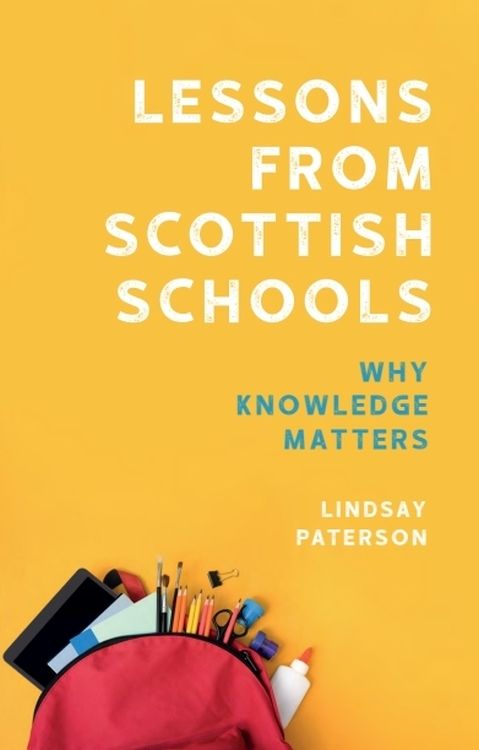
by Lindsay Paterson
Book Launch: Monday, June 15 • 7 PM – 8 PM
Join Lindsay Paterson as he celebrates the release of his book at Blackwells Edinburgh.
What is this book about?
The Scottish school curriculum is a case study of current educational fashions. The mantra is ‘twenty-first-century skills’ that cut across subject boundaries. Creativity, team-working and citizenship are thought to be more important than dry facts, individual achievement or competitive meritocracy.
Fashionable progressivism
We can sum this up as fashionable progressivism. Scotland’s ‘Curriculum for Excellence’ replaced an approach that was the polar opposite. Scotland used to be famous for its resolutely academic curriculum. That tradition stretched back through the beginnings of secondary schooling in the early years of the twentieth century, ultimately drawing on the universities of the Scottish Enlightenment. Between the 1960s and the end of the century, the tradition was gradually democratised without losing its essence: comprehensive secondary schooling in Scotland was persistently academic.
But the curriculum that is now in place is quite different. It was inspired by the radical euphoria, which accompanied the advent of the Scottish parliament in 1999. The curriculum has commanded cross-party support politically, and the enthusiastic endorsement of all the leading institutions of Scottish education – the teacher trade unions, the local authorities, the national advisory bodies.
Scotland’s educational decline
The outcomes for students have been uninspiring by international standards. The effects can be assessed using the three-yearly Programme for International Student Assessment run by the OECD – the PISA studies. These record the achievements of 15-year-olds in reading, mathematics and science. In all three domains, Scottish average attainment has fallen since 2000 – reading mainly between 2000 and 2006, after which it has broadly stabilised, mathematics declining steadily from 2003 to 2022, and science falling drastically from 2012 onwards. The decline has been as strong among the highest-attaining students as among the lowest. It has also led to a widening of social inequality of attainment. There has been no compensating strengthening in student well-being, or team-working, or citizenship, or creativity, despite the policy’s rhetoric.
This outcome is not disastrous – mediocrity rather than the radical improvement that was promised. Scotland remains somewhat above the European average in reading, and at around the average in mathematics and science. But average is not enough for a small country whose citizens have to compete in contexts on which they have little influence. It is also not enough in the light of Scotland’s distinguished educational history.
International comparisons
The decline can be understood through comparison with other countries, of three kinds. One is with places where the fashionable progressivism has not taken hold – for instance Estonia and Singapore. Both of these have high attainment in the PISA studies. Both may be characterised by the description of Estonian reforms from Edgar Krull and Rain Mikser (at the universities of Tartu and Tallinn): ‘all Estonian national curricula for general education have been academically oriented and subject centred’.
A contrasting comparison is with countries that have followed the fashion. In France, attainment has fallen and inequality has widened. Similar trends have been observed in two of Estonia’s neighbours, Finland and Sweden. Finland had very high attainment at the beginning of this century, but has declined steadily for two decades as its fashionably progressive curriculum has permeated the system. Sweden’s policy has interacted with marketisation, in which schools were freed from the control of local authorities. Progressivism and markets may seem strange partners, but the main feature of each is the abandonment of centrally prescribed standards.
The most encouraging comparison for Scotland, however, is with places which have replaced fashionable progressivism with a return to disciplinary knowledge. And the most relevant of these is England since 2010. Until the disruption caused by the pandemic, English attainment was steadily rising and social inequality was falling.
Not return to the past
Knowledge is more than facts. It is about structure – stories which explain facts, whether in science or literature or history. Applications of knowledge – skills – requires this structure too, whether in a workplace or in citizenship. All of these points are now well-established in high-quality research in cognitive science.
Equally evidence-based is the importance of expert teachers. Teachers have to be experts. They have to lead. They have to question students, constantly checking on understanding and on progress. The most student-centred classroom is most strongly led by the teacher, focusing always on the individuality of each student.
Why Scotland matters
Scotland’s transition from a highly academic curriculum to the very opposite is a lesson in the effects of fashionable progressivism. Scottish decline shows the world what not to do. It might in due course show that academic traditions, when suitably modernised in the light of science and experience, are worth recovering.
About the author
Lindsay Paterson is Emeritus Professor of Education Policy, School of Social and Political Science, University of Edinburgh. His main academic interests are in education, civic engagement and political attitudes. He has contributed to many debates in Scotland since the early 1990s on education, on social change, and on politics. He is a Fellow of the British Academy and a Fellow of the Royal Society of Edinburgh.