
by Bruno Ministro
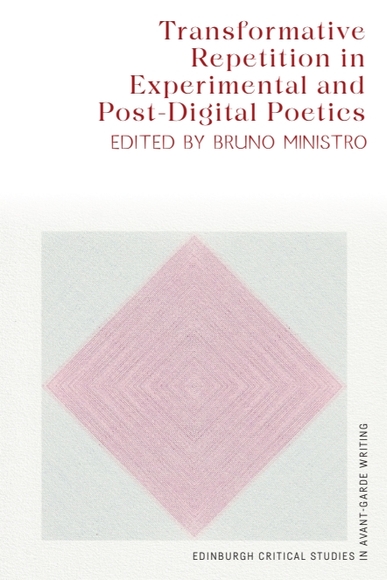
Transformative Repetition in Experimental and Post-Digital Poetics examines the transformative power of repetition in contemporary poetic practices.
Contemporary literary culture still struggles to accept that repetition is not the opposite of creativity but one of its conditions.
We have inherited a powerful myth of originality, namely the belief that literature emerges from singular, unrepeatable acts of invention. Yet poetry, across its long history, tells a different story. From oral traditions to avant-garde experimentation, repetition has always structured how poems sound, move and mean. It is not merely decorative or mnemonic, it is generative. Repetition does not simply reproduce the same, it produces difference.
Repeat After Me
This perspective is explored from multiple angles in Transformative Repetition in Experimental and Post-Digital Poetics, which brings together a range of approaches to repetition in contemporary poetry. Rather than offering a single definition, the volume examines how repetition operates across different media, languages and historical moments, tracing examples from concrete and visual poetry to conceptual writing and post-digital practices.
What emerges from this is not a unified theory but a constellation of practices: repetition as pattern, as procedure, as critical method, and as a way of engaging with the material and technological conditions of writing. Across these contributions, repetition appears less as a constraint than as a dynamic field through which poetic meaning is continuously reconfigured.
Don’t Repeat Yourself
When you repeat something, it is already something else. Yet repetition remains a suspect term. In everyday writing advice, it is something to avoid: vary your vocabulary, diversify your syntax, keep things fresh. Repetition, we are told, is dull. But this advice obscures its deeper cultural role. After all, repetition is how patterns form, whether linguistic, social, or technological. It is how ideas circulate, how narratives stabilise, how power operates.
Nowhere is this more evident than in our current post-digital environment. Contemporary text production through artificial intelligence systems relies fundamentally on repetition. Large language models generate sentences by identifying and reproducing statistical patterns in vast corpora. The result is language that feels fluent, even creative, but is underpinned by mechanical processes of iteration. In other words, repetition has become infrastructural.
Again, But Different
A crucial distinction needs to be made. Not all repetition is equal. The most compelling poetic practices today engage in what we might call transformative repetition: forms of reiteration that actively reshape their materials. These include strategies of appropriation, remix, permutation and recombination, techniques that foreground repetition while also disrupting it.
Experimental poetry offers a particularly sharp lens here. Works that repeat a word, a sentence or an entire structure often do so to expose the mechanics of language itself. They make repetition visible, audible, material. In doing so, they challenge readers to confront not just what is being said, but how it is being produced.
This is why repetition matters now more than ever. At a time when language is increasingly automated and standardised, repetition can either reinforce predictability or resist it. It can produce clichés, but it can also generate unexpected meanings. The difference lies in how repetition is mobilised, articulated, and transformed.
Repeat Differently
We might think of repetition, then, not as redundancy but as a field of possibilities. It connects past and present, analogue and digital, human and machine. It unsettles the boundaries between originality and copying, and it reminds us that writing has never been a purely linear act of invention, but a recursive process shaped by returns, echoes and variations.
The challenge is not to eliminate repetition from our cultural vocabulary. It is to rethink it. Because the history of poetry is, in many ways, a history of repetition, and its future may well depend on how we learn to repeat differently.

About the author
Bruno Ministro is the editor of Transformative Repetition in Experimental and Post-Digital Poetics. His research explores experimental poetry, electronic literature, and contemporary writing, drawing on approaches from digital humanities and comparative media studies.