
by Albert Pionke
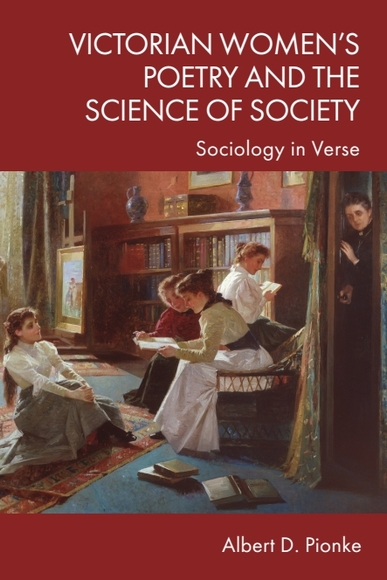
Victorian Women’s Poetry and the Science of Society: Sociology in Verse repositions Victorian women’s poetry at the centre of nineteenth-century Britain’s reception, construction, and representation of sociology.
As we train the children, so
Is the future made
That shall reign when we are low.
— A. Mary F. Robinson, “The School Children”
How do you know when bias has become structural? Perhaps when it has been institutionalized to such a degree that even those whom it affects accept their inequality as natural. They may even help to perpetuate it, whether purposefully or unintentionally.
We can see this naturalization of bias through institution building at work during the period of educational reform that culminated in the Education Acts of 1870, 1876, and 1880. Dedicated to the admirable goals of achieving near-universal basic literacy and numeracy through compulsory, publicly funded education for all British children up to age ten, these Acts also indirectly contributed to the near-complete erasure of women poets from British literary history.
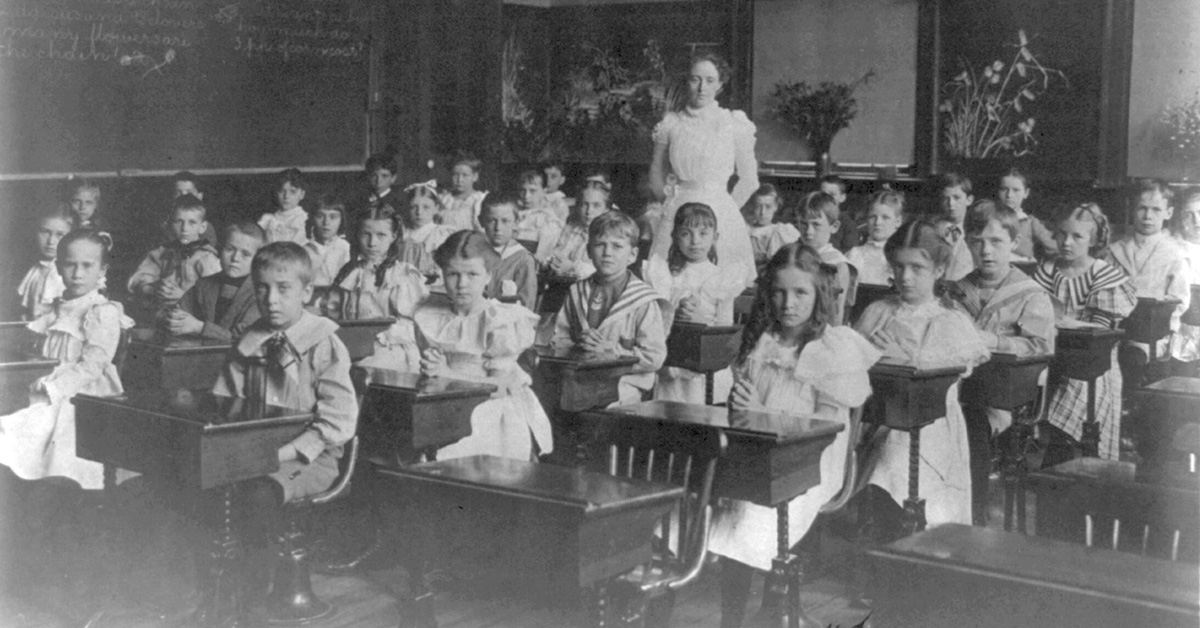
Especially for the working-class majority of these late-nineteenth-century elementary students, obtaining the skills of reading and writing was accomplished with the help of basic primer books known as readers. These still-recognizable ancestors of the modern literary anthology multiplied in the 1860s and after to capitalize upon the growing numbers of schoolchildren and the subsidies provided by the government for their education.
In many cases the first book, beyond the family Bible, to which working-class children were introduced, these readers overdetermined all students’ future reading choices. Moreover, despite the likelihood that students’ elementary teachers were women, the overwhelming majority of the authors, editors, and compilers of school textbooks were men, who had themselves been trained in single-sex boarding schools and universities. And their readers featured comparatively few works written by women.
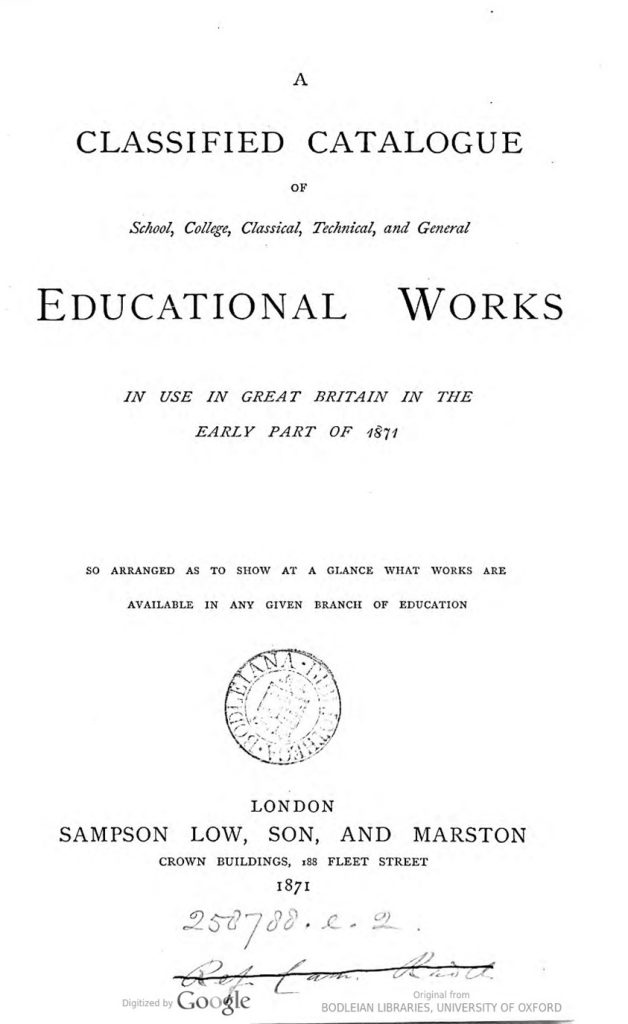
Publisher Sampson Low attempted to gather the titles of all available readers into their Classified Catalogue of School, College, Classical, Technical, and General Education Works, compiled and published in 1871, 1876, and 1887. Among the 8000-plus books contained in the 1871 edition were 345 likely to feature poems or poetic excerpts, arranged under three headings: 1) English Language, Literature (52); 2) English Language, Poetry for Schools (107); and 3) English Language, Readers (186). Within these 345 titles, only thirteen poets are mentioned by name, all men.
By 1876, the Classified Catalogue has grown to nearly 15,000 titles. Books composed in whole or in part of English poetry appear in 1876 under four headings: 1) English, Literature and History of the Language (69); 2) English, Poetical Selections (54); 3) English, Reader (193); and 4) English Classics (114). Among the twenty poets recognized as authors of “English Classics,” Felicia Hemans, as the author of Extracts, is the only woman. A twenty-five-percent increase to 430 total books thus allowed room for the inclusion of one book by one woman poet.
Matters did not meaningfully improve in 1887, by which time the Classified Catalogue contained approximately 25,000 books. These included works classified as 1) “English, Literature” (67); 2) “English, Poetry” (95); 3) “English, Reader” (344), included among which were a small number of titles specifically dedicated to Shakespeare and Milton; 4) “English Classics” (280) with Hemans—now recognized for Extracts and Select Poems—again the only female author among the twenty-six now accorded this status; and 5) a separate listing of 67 works by Shakespeare, who had so outgrown all other classics as to require his own category. Thus, even with 853 texts featuring poetry for use in schools, only two titles by a single poet were credited to a woman.
Institutionalized by a publishing industry chasing public school sales, this perhaps unconscious bias in favor of male poets would go on be naturalized through repetition. Starting in the 1860s and well underway by 1870, an entire generation of British children learned how to read, and in so doing learned what to read, by means of the embryonic anthologies they encountered in school. And those textbooks provided a decidedly partial picture of the poetry that had been and was being written in Britain and across the English-speaking world. Fully grown, with their horizons of expectations established by their own schooling, a subset of these pupils became teachers themselves in the 1880s and 1890s. These new teachers, the majority young women, would have faced the dramatically expanded choice of textbooks represented by the 1887 Classified Catalogue, which, although roughly three times larger than its 1871 predecessor, with two-and-a-half times the number of English books, listed only two by a single woman poet. Given this overwhelming evidence, the absence of poetry by women might well have seemed natural, thus creating a structural bias that would not be seriously challenged until the rise of second-wave feminism in the 1970s.

About the author
Albert D. Pionke is the William and Margaret Going Endowed Professor of English and Associate Dean of General Education and Academic Affairs in the College of Arts and Sciences at the University of Alabama.