
by Miranda Anderson
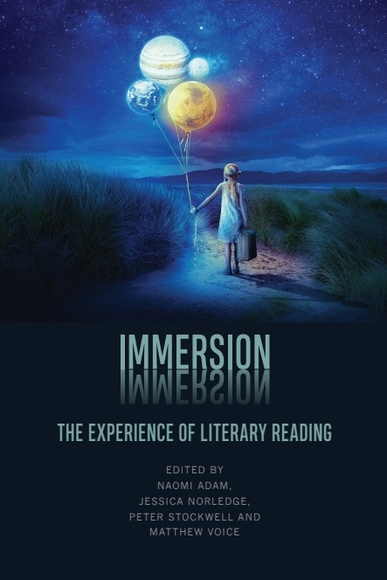
Immersion: The Experience of Literary Reading brings together researchers from across the world to explore the creation, effect, craft, and effect of a feeling of immersion in a literary or fictional world.
What if the laws of quantum physics do not imply multiple possible worlds but instead describe the co-existence of plural perspectives on reality? As Michael Brooks describes it: ‘Instead of myriad alternative realities continually branching away from our own, these relational interpretations build a singular universe up from within by stitching together many subjective perspectives.’[1] This new understanding of the universe impacts our understanding of experience. As in Immersion’s cover image, each of us holds an array of cosmic balloons, that represent our experience of diverse worlds.
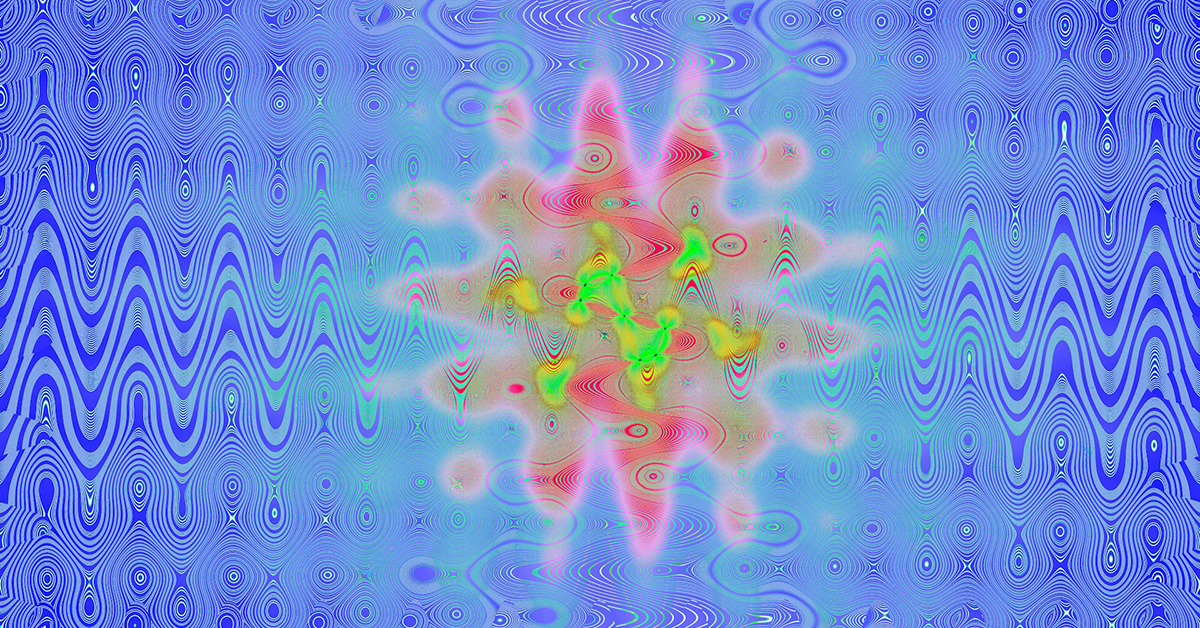
How does this work in practice? Fission-Fusion experience operates across multiple levels and expands and contracts across brain, body and world as necessary (Anderson 2015, 2023, 2026).
Each entity (e.g. you or a banana plant), process (e.g. reading this or digesting your dinner) and thought (e.g. wondering whether these are the best examples I could have chosen or thinking about which you would have used instead) is composed out of these arrays that sometime merge into being just inside the head and at other times span brain, body and world. It also relates to the concepts that we use to describe such entities, processes and thoughts, with each word having an array of associations that are derived from general uses and from our own experiential repertoires.
How does this inform how we experience literature then? The topic of the book in which my Open-Access chapter appears is ‘immersion’. Immersion describes the flow experience when you seem by means of the words you have read or heard to have taken mental flight and entered the world of the book. However, perhaps the word ‘immersion’ is too passive a term? When we take such mental flights, we fuse with the experiences we read about, and the words on the page have both shared and more particular associational arrays. Therefore, each of us experience distinct works, at the same time, as the author through their use of stylistic and literary devices constrain these imaginings, while assisting our onboard capacities for imaginative flight. Literary language enables a kind of spooky cognition as authors’ minds, by means of their words, play out across our minds recomposing them in the process. Afterwards, our linguistic arrays and experiential repertoires are widened through the relatively safe play of reading a book!
This linguistic play enables us to view things from the perspectives of other minds, times and places thereby increasing our cognitive flexibility. Such cognitive flexibility emerges from our engagement with any art form in diverse ways. Such cognitive flexibility is fundamental to enable us to shift between the sometimes necessary me-versus-you and us-versus-them stances of zero-sum logic to awareness of our interconnectedness to each other and to the world around us across space and time. Such cognitive flexibility is also necessary for each of us to open up the degrees of our freedom of thought. People talk about freedom of speech, but freedom of thought is much more fundamental and impacted by language being entrenched, limited and warped. For example, the commodification of search engines with the auctioning of sponsored key words, means that the words we first encounter when we search online are those merely with a narrow economic value, as described by Frederick Kaplan (2014). Widening our arrays of fission-fusion experiences through engaging with literature and the arts is of fundamental importance for us to attain individually meaningful lives and flourishing civilisations.
[1] Brooks, Michael. 2025. ‘How a quantum innovation may quash the idea of a multiverse.’ New Scientist, 6 January 2025.

About the author
Miranda Anderson is a philosopher of the arts and humanities, literary scholar, historian and curator. She has published 6 volumes on culture and cognition and curated The Extended Mind contemporary art exhibition with Talbot Rice Gallery. She has several works forthcoming on fission-fusion and is working on her first poetry collection. She is available to review films, art and culture: miranda.anderson@ed.ac.uk.