
by Rachel Dunn Zhang
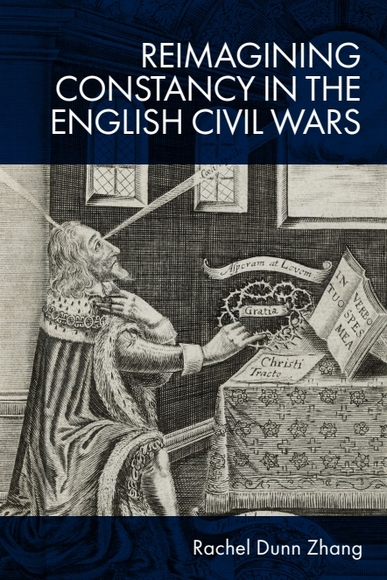
Reimagining Constancy in the English Civil Wars exposes writers’ reliance on conservative language during one of the most radical periods of English history.
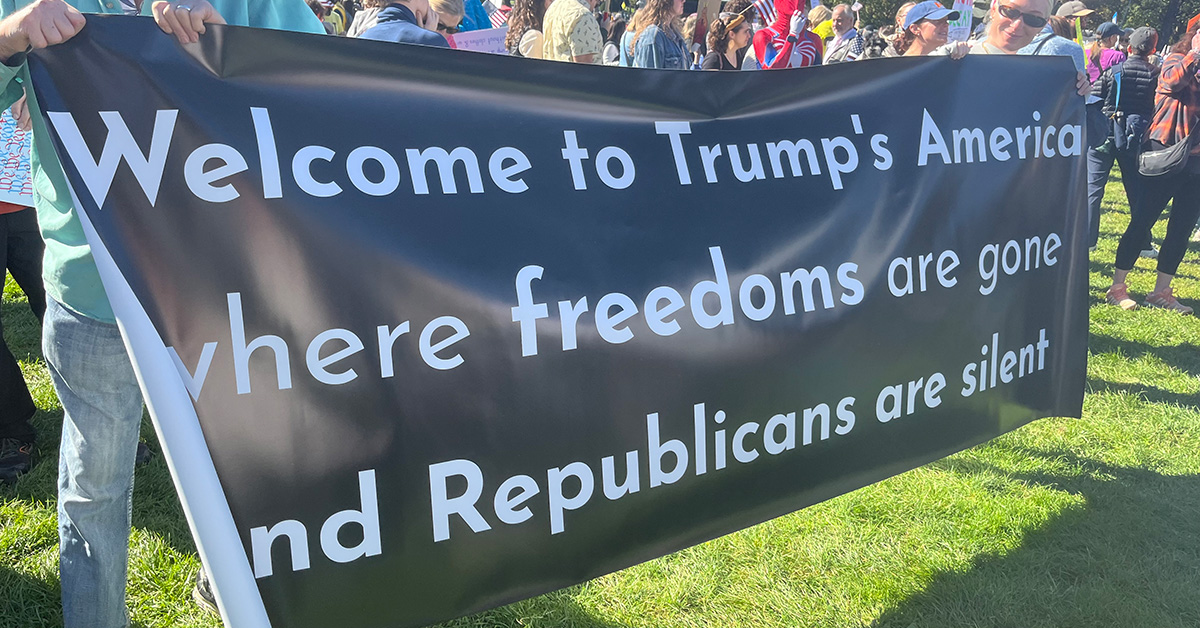
“I’m here for freedom, and you’re here for freedom,” screamed a Donald Trump supporter (later sentenced to 45 days in jail) storming the U.S. Capitol on 6 January 2021. Missing from his rallying cry was the extreme irony of his statement: Trump’s opponents also claimed the exact same language of “freedom”, such as one night of the 2024 Democratic Party convention, themed “A Fight for Our Freedoms.” Indeed, “freedom” has been used in the United States to justify gun rights—see the National Rifle Association’s newsletter, the Voice of Freedom—and gun control—the ACLU has warned of gun use leading to “restrictions on Americans’ freedom”; abortion access—e.g., New Jersey’s 2022 Freedom of Reproductive Choice Act—and abortion restrictions—see the Religious Freedom Institute’s description of attacks on pro-life organizations as assaults on “religious freedom.” In short, almost every side of every recent major political debate in the United States has been colored with the language of “freedom”.
This battle over what exactly “freedom” means in the United States exemplifies the type of battle over language and values explored in my book, Reimagining Constancy in the English Civil Wars. As my book shows, battles over language are much older than President Trump’s administration or even the United States itself. Indeed, as far back as the sixteenth and seventeenth centuries (and even earlier), people have waged political and religious war as a war over language, fighting for interpretations of terms and phrases backing their particular ideological narratives. In the English civil wars, the battle over “constancy” was a battle for authority in a time of competing authorities, a claim of godly ordination at a time when countless denominations and individuals claimed the same. It was a quest for a link to a recognized past when people were forcibly piercing into the future. And, not dissimilarly to some cases of “freedom” in the United States, it was the expression of an ideal when the ideal itself was undeniably absent.
Constancy in the English Civil Wars
My book details many cases of constancy’s inconstancy, from romances defending Catholicism to epicsarguing against the use of liturgy; in each case, writers define the word so as to promote their own view of the world. Milton’s Paradise Regained, for instance, defines constancy as neostoic steadfastness, lauding the “constant” Son as someone whose interior strength repels all external foes. This isn’t a pedantic declaration of doctrine, but a direct response to royalists’ promotion of liturgy and veneration of Charles I. For the king and his supporters, “[c]onstant forms of prayers” represented a uniformity of expression endorsed and supervised by the Church, and “constancy” a virtue inextricable from the “martyred” king. Milton’s “constant” Son, therefore, is a direct (if belated) rebuke not just to Eikon Basilike (1649), the most successful piece of propaganda in English history, but to an understanding of constancy fundamentally at odds with the individual expression central to Milton’s faith.
This is one of many examples of constancy’s polemical charge discussed in my book. Over and over again, people on all sides of the religiopolitical aisle in the mid-seventeenth century fought over what “constancy” means—proving, ironically, the inconstancy of the term and the period itself. Even as late as the Glorious Revolution, English literature and polemic upheld faith in the objectivity of an ideal despite decades-long proof of that ideal’s subjectivity.
The Unrealized Ideal
I wish this paradox were less familiar to me. Indeed, just as royalists and independents debated the correct understanding of constancy, American citizens and politicians alike have waged war over what freedom actually looks like. As George Washington University political science professor Elisabeth R. Anker documents in her recent book, “freedom” has been deployed so liberally, contrarily, and even harmfully that it has started to lose its salience. Anker even goes so far as to challenge freedom as a universal ideal, terming an inherently ambivalent, violent, “ugly” value.
Nonetheless, like Anker, I am not ready to dismiss the rhetoric of freedom completely. In the seventeenth century, constancy was used to perpetuate conflict, but it also undergirded aesthetic innovation; this inherently conservative language—remaining “constant” to something already extant—was a creative catalyst for republicans as well as monarchists, fueling literary experiments like a neostoic epic hero, a non-didactic emblem book, and a porous country house. The battle over constancy also forged emancipatory ethics, justifying religiopolitical ideas that continue to inspire readers eager for justice. This, I suspect, was why Milton and others retained their belief in constancy; like them, I find something beautiful in an ideal pushing people to strive for something beyond themselves, an ideal that offers a vision for a world better than the one we currently inhabit.
Indeed, it is often the failure of those ideals which drives political and social action. Martin Luther King, Jr. famously charged that more than 100 years after the Emancipation Proclamation, the African-American “still is not free.” Yet King did not give up on the idea of freedom, calling for all of his fellow citizens to “to make real the promises of democracy” and realize an “invigorating autumn of freedom and equality.” He still believed in a “dream” of being “free at last,” dream though it was. It was precisely the dreaminess of freedom that catalyzed King and his followers to work to overcome personal and systemic oppression.
We are now more than 150 years removed from the Emancipation Proclamation, and systemic injustice remains. Calls of “freedom” remain larger than ever, yet academic freedom is under threat, protestors are being arrested, and international law is being flouted. The contradiction between the ideals we uphold and actions conducted in the United States is now more overt than ever.
But just as constancy inspired beauty, I have to hope that freedom’s capacity for the creation of beauty and justice will overcome that of ugliness and oppression. Because, after all, what is the alternative? To lose hope for a future better than our present. And I insist on hope.

About the author
Rachel Dunn Zhang is an assistant professor at Emerson College focusing on the intersection of religion, politics, and literary form in the early modern period. Her latest book is Reimagining Constancy in the English Civil Wars (EUP, 2024).