
by Michelle Honeybun
‘His Vest, I Perceive, Is But Padded with Cotton!’: John Bull in Cotton Famine Poetry during the American Civil War (1861–5)’ is published in Issue 16.1 of Victoriographies.
Tell us a bit about your article.
My article focuses on the use of John Bull in Cotton Famine poetry. John Bull was the British national personification from the late eighteenth century and was frequently depicted in the satirical magazine Punch throughout the nineteenth century. During the American Civil War, he appeared in American and British newspapers as a vessel for protest, which created more emotional power in this transatlantic poetry. At the start of the American Civil War, Queen Victoria announced Britain’s Proclamation of Neutrality, which prompted an outpouring of emotionally charged poems. Much American poetry from Union newspapers used John Bull to express a sense of abandonment. Confederate poetry sought British support as both sides thought that the fact that Britain’s cotton mills were still heavily reliant on America’s slave-grown cotton would prompt British intervention on the side of the Confederacy. At the start of Civil War, three quarters of the raw cotton in Britain’s mills came from America’s Southern plantations; hence the line ‘His Vest, I Perceive, Is But Padded with Cotton!’, taken from a Union poem that was mockingly titled, ‘English Patriotism’. British poetry employed John Bull to assert a desire from the British to maintain its abolitionist reputation despite its neutrality in a war fought largely for the abolition of slavery. This poetry spanned the transatlantic world made possible by rapid engagement with the poetry on both sides of the Atlantic.
What is Cotton Famine poetry?
I define Cotton Famine poetry as poetry written during the American Civil War that commented on the connection between Britain’s cotton mills and America’s slave-grown cotton. Cotton Famine poetry reveals the complexity of opinion of ordinary people on contentious topics such as international relations, nationhood, commerce, and slavery.
What inspired you to research this area?
I have always been intrigued by the role personification plays in the spread of emotion, and the Victorians were adept at using it in poetry to spread awareness of political matters. My initial research started during my PhD where I accessed the Poetry of the Lancashire Cotton Famine (1861-5) database, https://cottonfaminepoetry.exeter.ac.uk/. This digital humanities project was led by Exeter University professor Simon Rennie. Out of the 400 some poems on the database, twenty eight featured John Bull. I then looked for more poetry and cartoons of John Bull in online and physical archives in the USA.
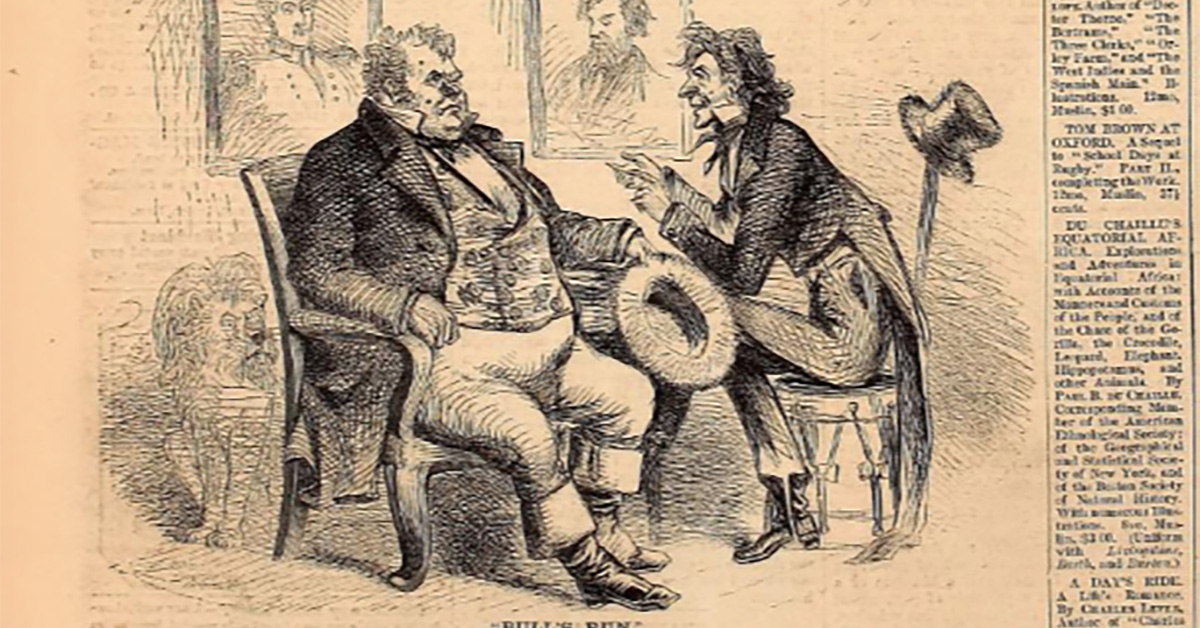
Tell us more about the image you picked as a header.
The image was published in Harper’s Weekly 24 August 1861, and I feel that it encapsulates the Union’s distrust of Britain’s neutrality. The Union felt that Britain’s desire for cotton overrode any previous abolitionist tendencies. Britain’s need for cotton is portrayed through Bull’s pleading line: ‘Ah! Brother Jonathon, this war’s all very well, but where am I going to get my cotton?’ Jonathan replies with a reference to the Revolutionary War and the War of 1812.
What was the most exciting thing about this project for you?
I enjoyed discovering the role newspaper poetry played in the spread of information during the American Civil War and how it worked alongside articles and cartoons.
Did your research take you to any interesting places?
On a research visit to the Library of Virginia in Richmond, Virginia, I stopped at the Appomattox Court House National Historical Park, Virginia, the place where the American Civil War came to an end. Visitors there are able to see the parlour in the Wilmer Mclean House where Confederate General Robert E. Lee surrendered to Union General Ulysses S. Grant on 9 April 1865.
Has your research in this area changed the way you see the world today?
Yes. I have developed a deeper understanding of how the press works to manipulate people. The ‘cut and paste’ journalism we see today has been around since mass media production. In today’s world, people are able to rapidly share content through social media whereas the Victorians used newspaper poetry to react to contemporary events. In my research, I unearthed poems where stanzas had been removed to suit the needs of the publication before being recirculated. Today, news outlets often edit or leave out information to support a particular ideology because biased news carries more emotional force, lending greater appeal to news stories.
What’s next for you?
I am turning my doctoral thesis into a book manuscript, which I intend to submit to a press for consideration later this year. Titled, ‘Figures of War and Cotton: British and American Poetry during the American Civil War (1861-65)’, it details the use of several personifications in newspaper poetry, arguing how their use can increase a reader’s emotional reaction to a poem.

About the author

Michelle Honeybun graduated from the University of Exeter in February 2024 with a Ph.D. in English. Her research interests include personification in poetry, affect, gender and sexuality, and the Victorian press. She is currently teaching at The University of Olivet in Michigan, USA and can be contacted at mhoneybun@uolivet.edu.