
by Jeroen Wijnendaele
Staging the scene
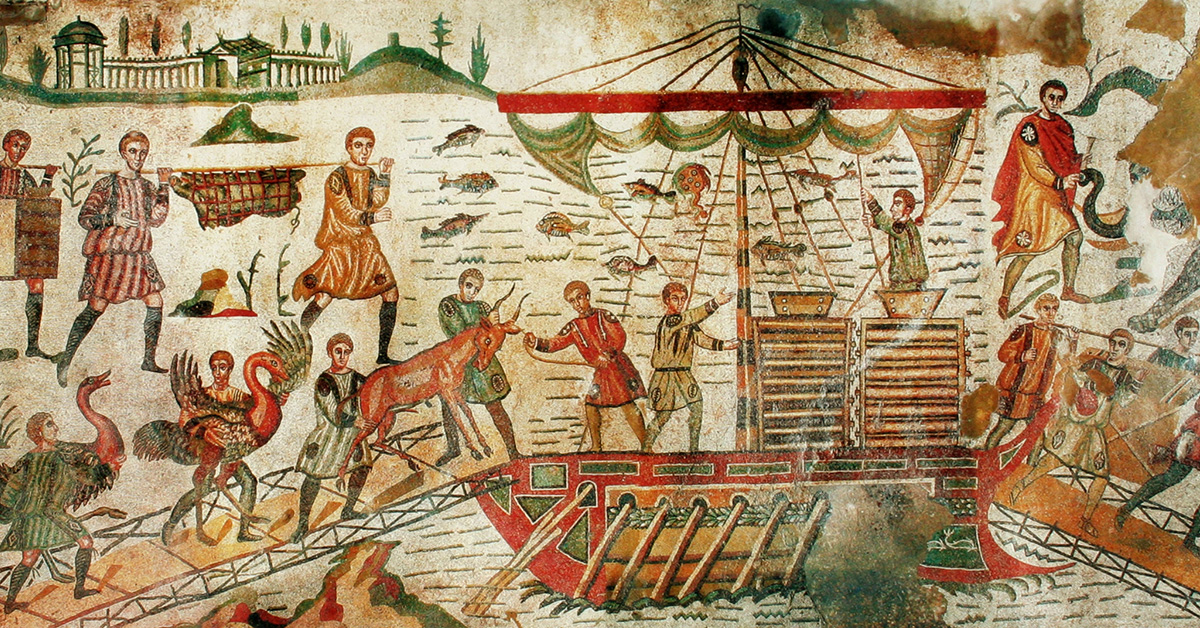
The Villa Romana del Casale near Piazza Armerina is a miniature Late Roman equivalent of Pompeii. Located in the heart of Sicily, this early fourth century villa has preserved a wealth of contemporary art precisely because its original site was of no particular prominence. It certainly ranked nowhere near other sites of Late Roman heritage that have stood the test of time such as Ravenna, Split or Trier. Yet it is this site which has given us such marvelous snapshots of Roman art as the bikini girls or the aristocratic hunting scene.
One mosaic associated with the latter theme, depicts the capture and transport of exotic animals (such as elephants and ostriches) demonstrating the reach the Empire still possessed in this era. It also shows, what Kate Cooper and Jamie Wood recently dubbed, “the violence of small worlds” with one labourer being flogged by his overseer. This scene especially demonstrates the physical reality of what it entailed being part of the Late Roman world. Hence it presents an apt background for our series.
Genesis
Edinburgh Studies in Late Roman History is the first international book series exclusively dedicated to the core domain of Late Antiquity. The Late Roman Empire is at the foundation of Byzantine, Early Medieval and Late Antique studies. At the dawn of the 20th century, art historians recognized the Late Roman period as not one of decadence and decline, but that it possessed its own distinct splendour setting it apart from earlier Roman civilization, which they termed Spätantike.
From the 1960s onwards, the impetus for the study of the third to the seventh century as a distinct historical period received new momentum following two publications. First, A.H.M. Jones’ The Later Roman Empire remains, sixty years later, an unreplaceable tour de force, examining every institutional aspect of the empire from the accession of Diocletian (284 CE) to the death of Mauricius (602 CE), in over a thousand pages.
Yet it was Peter Brown’s The World of Late Antiquity in 1971 that has become the call to arms for Late Antiquity in the Anglophone world. Brown’s greatest achievement was not just consolidating the independent study of this period, but also uniting scholars working in previously separate disciplines such as Art History, Classics, History, and Patristics, among others. However, the Late Antique field has expanded considerably past its initial borders to become a series subfield itself.
Rationale
Brown’s famous maxim, “Late Antiquity is always later than you think,” has led to ever wider chronological boundaries in both directions, including on one end the Antonine Dynasty (96-192 CE) and the Carolingians and the Abbasids at the other end (c. 750-1000 CE). While intellectual threads connect these ends across the first millennium, such a long time and wide geographic span loses cohesion as a book series encompassing dozens of subfields that would require scores of subfields experts, to the point one could ask what the world of Antoninus Pius c. 150 still has in common with that of Karolus Magnus c. 800 (as already famously pointed out by Andrea Giardina’s “Esplosione di tardoantico” in 1999).
From a book series perspective, this also means encroaching upon existing series in which Byzantinists, Early Islamicists and Early Medievalists have existing publications. While our series welcomes subfield specialists from these groups, it focuses on immediate transformations within and after the Late Roman Empire, from the apex of the crises of the third century to the dawn of the Arabic conquests in the seventh century.
The Roman Empire thus remains at the core of the series, which remained a Mediterranean-wide empire in this era, with a far more profound political, economic, and institutional influence on its neighbours than afterwards.
Diversity
However, our series does not focus only on Roman imperial structures, but also on states and peoples on its borders and that came after its political end. The series encompasses the western kingdoms, Mauri societies in North Africa, Armenia and the Caucasian polities, and the “barbarian” groups living on the imperial frontiers and interacting with it as long as they have links with the Roman world.
In the conclusion of his The Roman Empire in Late Antiquity (2018), which neatly harmonizes the Jonesian and Brownsian approaches, Hugh Elton stated that “[b]etween these two periods [from Gallienus to Heraclius] there stood a flourishing Late Roman Empire characterized by diversity, good government, and hard-working emperors”. Diversity is key to our series as well.
Our editorial board is intentionally designed to represent the four major languages in which scholars publish: English, French, German, and Italian. Far too often, scholarship from one language in this period does not sufficiently draw from the three other foundational languages of the discipline. Our diverse board, will also help the current generation of European, Hispanic and Lusophone scholars who seek to publish their works in English. This is not only to ensure that books published in the series will take account of the entire field, enhancing their quality, but also to entice scholars across Australasia, Europe, Latin- and North-America to submit proposals of outstanding quality.

About the author
Jeroen W.P. Wijnendaele is Visiting Professor and Gerda Henkel Fellow at Ghent University. He is the founding editor of Edinburgh Studies in Late Roman History. Over the past decade, he has published numerous articles and book-chapters on the political, social and military history of the Late Roman Empire.
He is also the author of The Last of the Romans. Bonifatius, warlord and comes Africae (Bloomsbury Academic 2015), and editor of Warfare and Food-Supply in the Late Roman Empire (Journal of Late Antiquity’s 2019 theme-issue) and Late Roman Italy: Imperium to Regnum (Edinburgh University Press 2023).
At the moment, he is preparing a new monograph on Rome’s Disintegration. War, Violence, and the End of Empire in the West for Oxford University Press.