
by Naoise Murphy
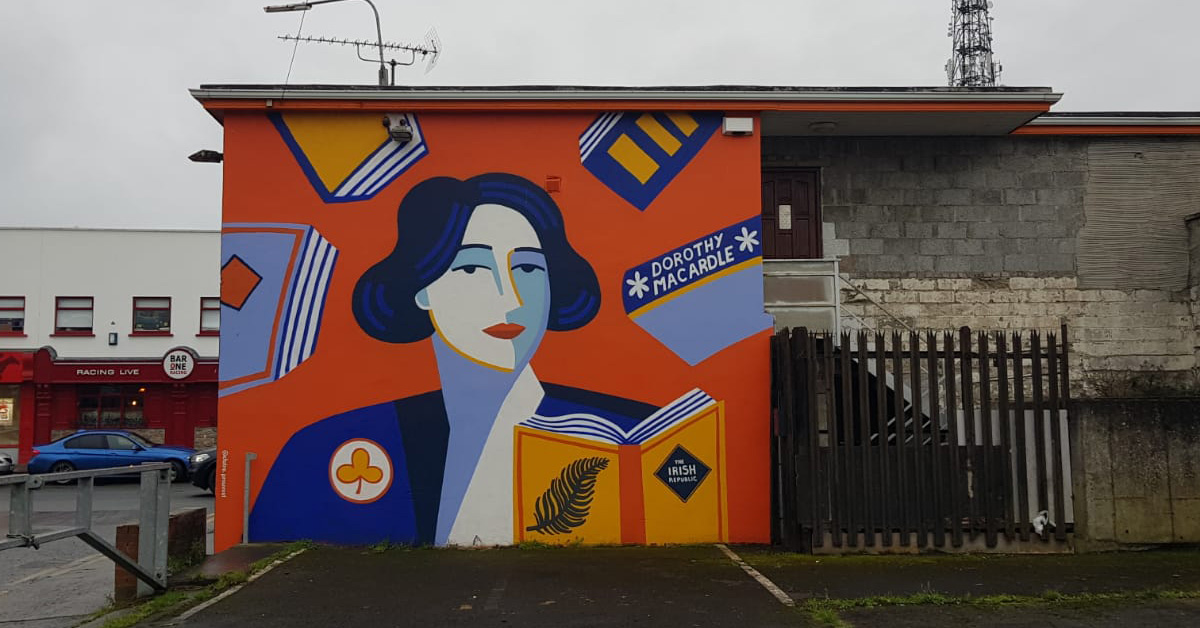
Header image: Dorothy Macardle mural by Claire Prouvost for SEEK Dundalk Urban Arts Festival, August 2020. Photo by Naoise Murphy.
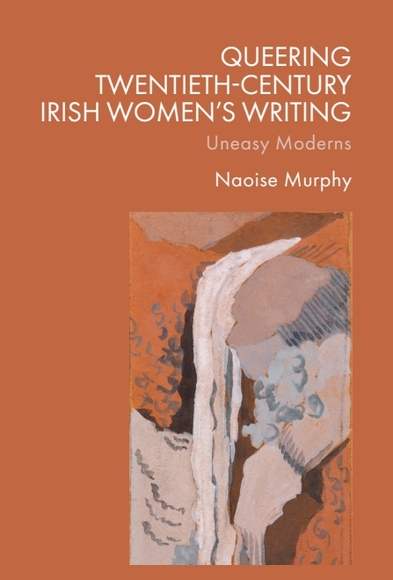
Queering Twentieth-Century Irish Women’s Writing: Uneasy Moderns is a queer, postcolonial reading of twentieth-century Irish women’s writing.
One evening in September 2023, walking down the North Circular Road in Dublin, I came across an incongruous celebration of Irish women writers. Under capital letters reminding me that I was passing ‘MOUNTJOY PRISON’, the republican historian, propagandist, playwright and novelist Dorothy Macardle gazed serenely out at the passing traffic. It was an informational poster produced by the Irish Prison Service Museum, marking Macardle’s incarceration in Mountjoy during the Civil War. There were images of her short story collection Earthbound (1924) and her bestselling The Irish Republic (1937), and the key fact highlighted under the image of her face was that ‘Macardle’s first novel Uneasy Freehold was made into an Oscar-nominated film’.
At the time, I took a photo, sent it to my girlfriend with an indignant comment (‘prison in Dublin doing girlboss feminism’), and carried on with my journey, but I couldn’t shake the feelings it left in me. The contradictions and inappropriate implications multiply the longer you think about it. It’s as if Macardle is a famous alumna, as if Mountjoy is taking credit for her literary achievements. In a twisted way, this makes sense. The poster quotes Macardle’s description of how she was ‘transformed from the position of lecturer in Alexandra College to that of a military prisoner in Mountjoy Jail’. Losing her respectable middle-class identity, forming relationships with other political prisoners, undergoing harrowing physical violence; the experience of incarceration politicised Macardle even further. Her writing targets the institutions of the emerging Irish state that took over the oppressive functions of colonial rule: the classed, racialised and gendered policing of dissent. This is a celebration of Macardle’s writing at the site of some of the most violent experiences of her life, by the institution responsible for that violence – an institution in which people are still incarcerated today.
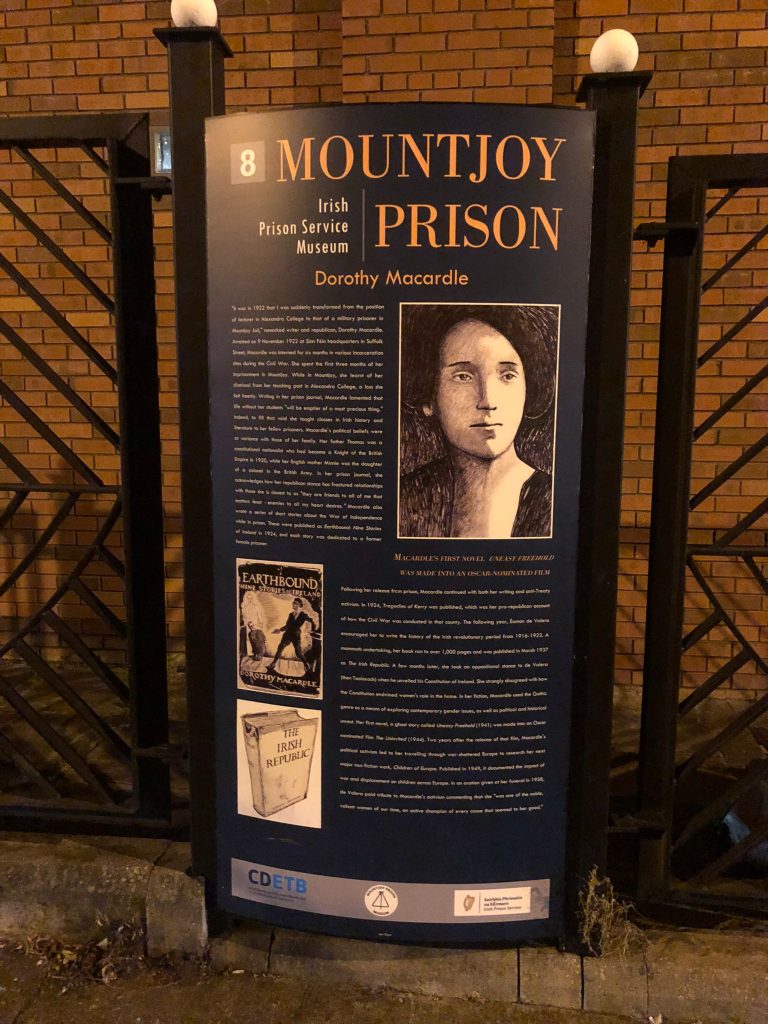
Macardle appears alongside other famous women prisoners: Margaret Buckley, Mary MacSwiney, Constance Markievicz, the Suffragettes. Prison matrons are also included, though surely there’s some important distinction that should have been made here between voluntary and involuntary occupants of the space. I don’t think I’m wrong in assuming that the public historians responsible think they are ‘doing feminism’ of some variety. The Mountjoy poster is one of the more extreme examples of a phenomenon I’ve been studying for years – the use of ‘women writers’ to create a vague, celebratory image of progressiveness, papering over the ongoing violence of state projects. It’s not usually so stark as a literal prison; the writers’ politics don’t usually conflict so openly with the institution doing the celebrating. For me, this phenomenon is illustrative of a widespread inability to narrate the relationship between colonial/postcolonial violence, gender and sexuality with any coherence in the public sphere.
This is why the story we tell about Irish women’s writing in the post-independence period needs queering. The narrative of Ireland’s belated but confident modernisation that I grew up with – the ‘tolerance’ and ‘progress’ that animated mainstream discourse around marriage equality and Repeal – has never been able to account for the realities of life in contemporary Ireland, never mind actually provide a stable foundation for a more equal society. (Indeed, we are increasingly witnessing the collapse of these liberal fantasies playing out in real time.) It can’t account for the work of a complex, diverse, contradictory, and self-divided group of ‘women writers’, either, and instead casts them all as untimely harbingers of liberal modernity, always somehow ‘ahead of their time’.
When I talk about queering, I’m following in a tradition of queer and feminist thought that embraces bad feelings, rather than pushing them aside in favour of simplistic, optimistic strategies. In the work of a select group of twentieth-century writers (Macardle, plus three of those most often chosen as exemplary of the period: Elizabeth Bowen, Kate O’Brien and Molly Keane), I find a complicated array of queer bad feelings. There’s postcolonial anxiety, postimperial melancholia, camp disaffection, a persistent sense of being haunted. Once we set aside the desire for ‘Irish women’s writing’ to a) function as a coherent literary category and b) herald progressive social change, we can begin to analyse what’s really interesting about writing by women in the post-independence period.
Each of these writers ultimately escapes our changing definitions of the ‘modern’ and resists any comforting narrative of progress. They tell a queerer, messier story, where racism is enfolded into progressive politics, or queer sexuality is used to thematise the colonial mindset. Queer and feminist ways of reading give us a language to account for the sinking feeling in the stomach when faced with something like Mountjoy’s Macardle poster. Faced with this kind of wilful misreading, papering over the mechanisms of violence and domination that continue into the present, queer reading leans in to discomfort and incongruity, because that’s where queers have always found a way to thrive.

About the author
Naoise Murphy is a Leverhulme Early Career Fellow at the University of Manchester and the author of Queering Twentieth-Century Irish Women’s Writing: Uneasy Moderns, published by Edinburgh University Press in December 2025.