-
Interview with Maggie Humm
Read more: Interview with Maggie HummMaggie Humm reflects on feminist criticism, life-writing, and Virginia Woolf’s influence.


Maggie Humm reflects on feminist criticism, life-writing, and Virginia Woolf’s influence.

By Dominic Hinde In its nine years in power, Scotland’s Scottish National Party (SNP) government has sought to redefine many areas of how the country is governed. In many fields, from healthcare to education, the party has attempted to create…
By Gordon Graham Not so very long ago, it was quite widely accepted that Britain’s most significant contribution to the development of philosophy was ‘empiricism’ and that its great exponents were the Englishman John Locke, the Irishman George Berkeley, and…

By Keith Shaw Tucked away towards the end of the recent document announcing the ‘Devolution Deal’ between the Treasury and the seven local councils in the North East of England, is a commitment to working in collaboration with Scotland to…

By Asher Jiang The concept of physical power in its modern forms has been introduced by Sir Isaac Newton in his great work Philosophiae Naturalis Principia Mathematica. Although Newton has embedded this concept into a precise mathematical framework, the power…

By Giovanni Gellera Until recently, the question ‘What was philosophy like in Scotland before the Enlightenment?’ met a standard answer reminiscent of the famous Augustinian warning to those who dared to ask what was there before the beginning of time:…

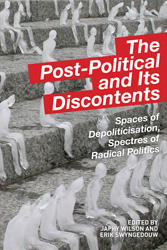
Erik Swyngedouw and Japhy Wilson explore the parallax gap between struggles for democracy against a backdrop of growing political disaffection.

To celebrate the new edition of Quentin Meillassoux: Philosophy in the Making, we bring you an exclusive author Q&A with Graham Harman. Questions by Jon Cogburn.

David Cameron has been avoiding the m-word. In his recent speech about extremism, the word ‘multicultural’ was noticeable by its omission for two reasons. First, Cameron said that Britain was a ‘successful multiracial and multi-faith democracy’ and a term like…
The problem of how philosophy is to approach the word politics is especially difficult, as it is itself a stake of political struggle and thus steeped in equivocity. The question of just who is and who is not considered political, and what objects are part or are not part of political consideration, is itself always intrinsic to politics. Philosophy thus encounters the word politics as inherently equivocal or, in Badiou’s terms, as a ‘split word’.