
by Douglas Kerr
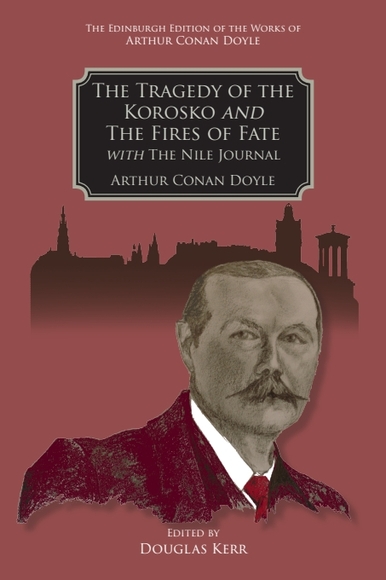
The Tragedy of the Korosko and The Fires of Fate
with The Nile Journal brings together Arthur Conan Doyle’s Egyptian-themed works, based on his imperial travels.
In November 1895 Arthur Conan Doyle arrived in Cairo with his wife Louise (Touie) and his sister Lottie. Touie was consumptive, and had been advised to winter in a dry climate. The little party were tourists. They climbed the Great Pyramid, went round the Egyptian Museum, and sailed up the Nile. But Conan Doyle was also a professional writer, always on the lookout for copy. He recorded his impressions in a journal, published here for the first time.
Although this was his first visit, Conan Doyle already knew something of Egypt. The country had been a popular theme in the European imagination, a place of mystery and glamour that had inspired various European works of art in the nineteenth century, from Shelley’s sonnet ‘Ozymandias’ to Verdi’s opera Aida.
Conan Doyle had already written two stories about Ancient Egypt. The first, ‘The Ring of Thoth’, is a romance about an Egyptian who discovers the elixir of life, but is prevented from sharing it with the woman he loves, who dies suddenly of the plague. He wanders the earth for millennia searching for the antidote, which will allow him to die and join his beloved. At last (and because this ancient scientist has kept up with modern Egyptological scholarship) he finds it in the Egyptian collection in the Louvre, and is reunited in death with the mummy of his lover. It is a touching, exotic, romantic story. Not so ‘Lot No. 249’, about an Oxford undergraduate in Oriental studies who has discovered an ancient spell that can bring a mummy back to life. He uses the mummy to attack his enemies, one of whom, memorably, ‘could see, as he threw back a glance, that this horror was bounding like a tiger at his heels, with blazing eyes and one stringy arm out-thrown’.
This is the first example in literature of a vengeful mummy story. The Gothic ‘horror’ is defeated in the end by sturdy common-sense British students. ‘You’ll find that your filthy Egyptian tricks won’t answer in England.’ These two tales represent the light and dark sides of Egypt under Western eyes; a place of fascinating and enlightened ancient culture, but also of superstition, cruelty, and fanaticism. These responses would come together in 1922 when the tomb of Tutankhamun was discovered. Its fabulous treasures were universally admired, but there soon arose the rumour, confected by the press, of the ‘curse of Tutankhamun’, supposed to strike down those who had violated the tomb. Interviewed as an expert on the supernatural, Conan Doyle himself told the press it was possible some occult influence had caused the death of Lord Carnavon, sponsor of the dig. He didn’t mention that his own story, and others that followed it, probably contributed to people’s readiness to believe in the curse.
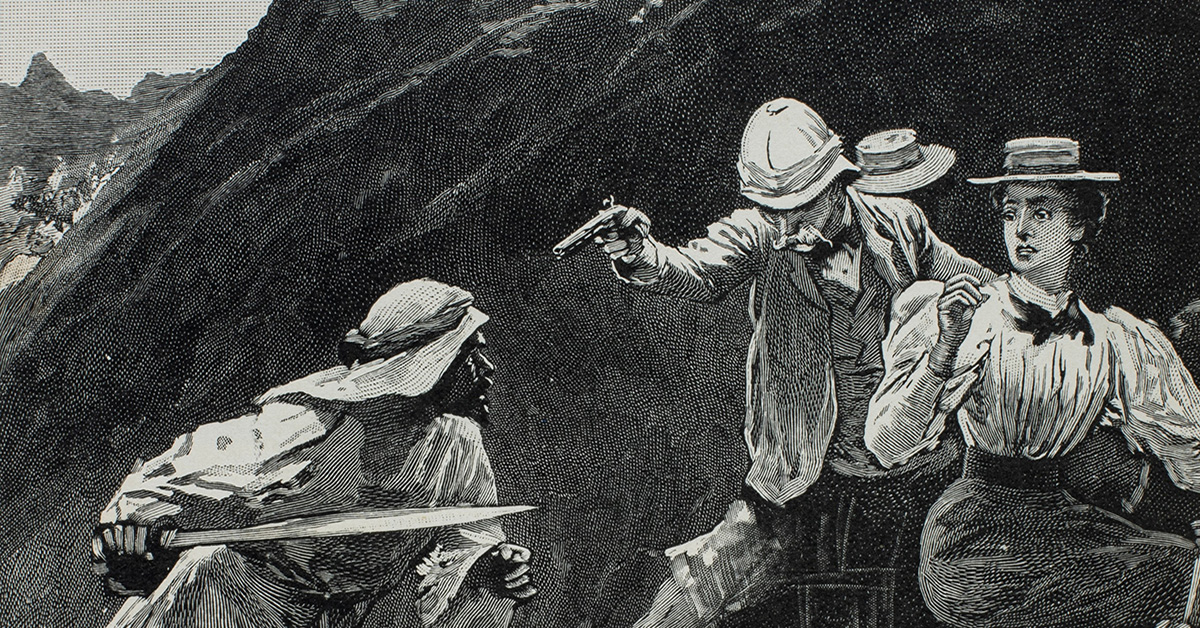
Travelling on a Thomas Cook steamer up the Nile in January 1896, Conan Doyle and his party duly visited the ruined tombs and temples along the way. At the temple of Dendera he climbed down into a secret chamber behind the shrine, where bats hung thickly on the ceiling and flew about his head. But he passed over this highly Gothic moment. His attention was turning from ancient to modern Egypt. In a village near Abu Simbel, he wrote in his journal, ‘If I were a Dervish General I would undertake to carry off a Cook’s excursion party with the greatest ease.’ This was the seed for his novella The Tragedy of the Korosko, an adventure story set in the Nubian badlands, in which tourists on the Nile are captured and dramatically rescued.
For the Nile in 1896 was a dangerous place. Upriver in Sudan, which was nominally an Egyptian possession, a revolt had broken out under the leadership of the religious leader called the Mahdi. Egypt at this time was under British administration and control, and the Egyptian army was commanded by British officers. In 1883 the Mahdist forces, called Dervishes by the British, met and wiped out an Egyptian army of eight thousand men under Colonel William Hicks. In 1885 they captured Khartoum and killed its commander, General Gordon, much to the horror of the British public at home.
Ten years later the British were preparing an expeditionary force under H. H. Kitchener to reconquer Sudan. Conan Doyle, only recently back from his Nile excursion, got himself appointed a war correspondent, and accompanied Kitchener’s army upriver for a month. He cut a very amateur figure. He was by no means an expert camel-rider, and had equipped himself with a huge revolver of Italian make, and a water bottle than tasted of turpentine. But he loved it. He was a lifelong imperialist, and admired both the soldiers and the hardened war reporters he travelled with.
He had to return to Cairo before the force saw any action, and he almost certainly never met a Dervish. But he reported what the British officers told him. ‘The Arab of the Soudan is a desperate fanatic who rushes to death with the frenzy of a madman, and longs for close quarters where he can bury his spear in the body of his foeman.’ There may have been some basis for this stereotype of bloodthirsty zealotry. But it doesn’t take account of the fact that most Dervishes had no firearms. Faced with an enemy equipped with modern weaponry, getting quickly to close quarters was the only chance for a footsoldier with a spear.
As Kitchener slowly made his way upriver, Conan Doyle was back home, writing about Egypt. Instalments of The Tragedy of the Korosko came out regularly in the Strand Magazine, as if they were despatches from the front. The adventure story, and Kitchener’s campaign, both ended with a triumphant battle. ‘The nineteenth century,’ Conan Doyle wrote, ‘had been revenged upon the seventh.’

About the author
Douglas Kerr is Honorary Research Fellow at Birkbeck College, University of London and Honorary Professor of English and former Dean of the Faculty of Arts at the University of Hong Kong. He is the author of Orwell and Empire (2022), Conan Doyle: Writing, Profession, and Practice (2013), Eastern Figures: Orient and Empire in British Writing (2008), and Wilfred Owen’s Voices: Language and Community (1993). He is General Editor of the Edinburgh Edition of the Works of Arthur Conan Doyle (22 vols), for which he has edited Conan Doyle’s autobiography, Memories and Adventures (2022).