
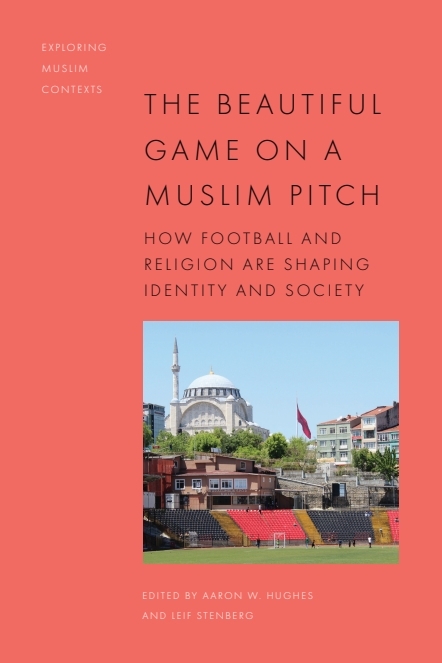
As the FIFA World Cup 2026 approaches the final, read an edited extract from The Beautiful Game on a Muslim Pitch: How Football and Religion are Shaping Identity and Society, exploring how football, religion and politics shape Muslim societies.
The Beautiful Game on a Muslim Pitch is Open Access. Visit the book’s webpage to download the Ebook for free.
Football and Power in Muslim-majority countries
By Aaron W. Hughes and Leif Stenberg
An edited extract from the introduction of The Beautiful Game on a Muslim Pitch: How Football and Religion are Shaping Identity and Society.
Football entered most Muslim-majority countries as part and parcel of the colonialist project. So its connection to power in Muslim contexts is perhaps not surprising. This is not to say, however, that the sport functions in a neo-colonial fashion today. Far from it: if anything, a host of local ends have domesticated and absorbed football. Groups and governments in countries like Algeria and Lebanon have frequently used football as an organisational tool to challenge colonialism. Conversely, Turkish and Saudi Arabian governments have used the sport to further consolidate their power and exert greater control.
In this way, various state and/or religious elites have increasingly harnessed football to justify and legitimate their ends. The flip side of this is that the sport also offers forms of resistance to such elites as subaltern communities seek to use the game to establish their own identities. Football becomes the medium in which we see a host of issues surrounding gender, class and race play out.
Football as soft political power
In modern Muslim contexts, we increasingly see political powers harnessing football. From the Muslim Brotherhood in Egypt to Erdoğan’s Turkey to Iran’s Islamic Republic, football is used and controlled with the aim of legitimation, attracting and training youth, and enforcing who can and cannot engage with the game. Despite objections from conservative Wahhabi and Salafi religious leaders, Gulf states have invested heavily in football, both domestically and internationally. It is then used as a form of soft power. For example, look at the 2022 World Cup in Qatar and the Saudi Pro League’s recent spending spree.
Places like Iran and even Saudi Arabia, where theological power is at its most conservative and influential, have tried to exclude women from stadiums and public spaces where football is watched. Conservative theocracies attempt to control women by limiting their participation in anything to do with football. But they have not been able to do this entirely, as Nazanin Shahrokni shows in Chapter 7.
Football as resistance
Government use of football has not stopped certain subaltern groups from also appealing to football to resist such power with the aim of either creating new, or maintaining existing, identities. How, for example, do footballers and their fans see themselves? How does football reinforce certain ethnic, religious and social identities?
Chapter 1, for example, opens with one of the most famous strikers in world football. Karim Benzema, formerly of Real Madrid and more lately of al-Ittihad in Saudi Arabia, has become a catalyst and a symbol of resistance to the French state in many of the country’s suburban communities with significant populations identifying with North African or other Muslim-associated origins.
Women and girls have also used football as a site of resistance. To use an example from Chapter 4: in 2007, a referee ordered a 12-year-old player to remove her hijab. The girl, from Ottawa in Canada, refused to play without it. This set off a seven-year international debate. FIFA resisted the use of head coverings – first on religious grounds, then on safety grounds – while Muslim groups pushed back. FIFA only overturned the ban in 2014. This was just before the U17 Women’s World Cup in Amman, Jordan: the first FIFA tournament in the Middle East. And, in chapter 5, we learn how a group of young women in a small community in northern Pakistan used football to carve out an identity for themselves despite the challenges of various political and religious forces.
Football and Islam, on and off the pitch
The Beautiful Game on a Muslim Pitch seeks to contribute further to the complex ways that religion intersects with football on and off the pitch. To this end, the chapters in the book tend not to address religion explicitly. But they reveal the manifold ways that religion is caught up in a host of gendered, racialised and political/social investments. The only way to understand these investments, we argue, is to account for the way religion is configured in and with them and, of course, vice versa.
About the authors
Aaron W. Hughes is Dean’s Professor of the Humanities and the Philip S. Bernstein Professor of Religion at the University of Rochester. Hughes specialises in three fields: Islamic Studies, Jewish Studies and Theory and Method in the Study of Religion, and has written numerous books in all three. He is co-editor of the book series Advances in the Study of Islam at Edinburgh University Press.
Leif Stenberg is Professor in Islamic Studies at the Aga Khan University Institute for the Study of Muslim Civilisations (AKU-ISMC) and a visiting professor at Karlstad University. He is the co-editor of What is Islamic Studies? European and North American Approaches to a Contested Field, also in the Exploring Muslim Contexts series at Edinburgh University Press.