
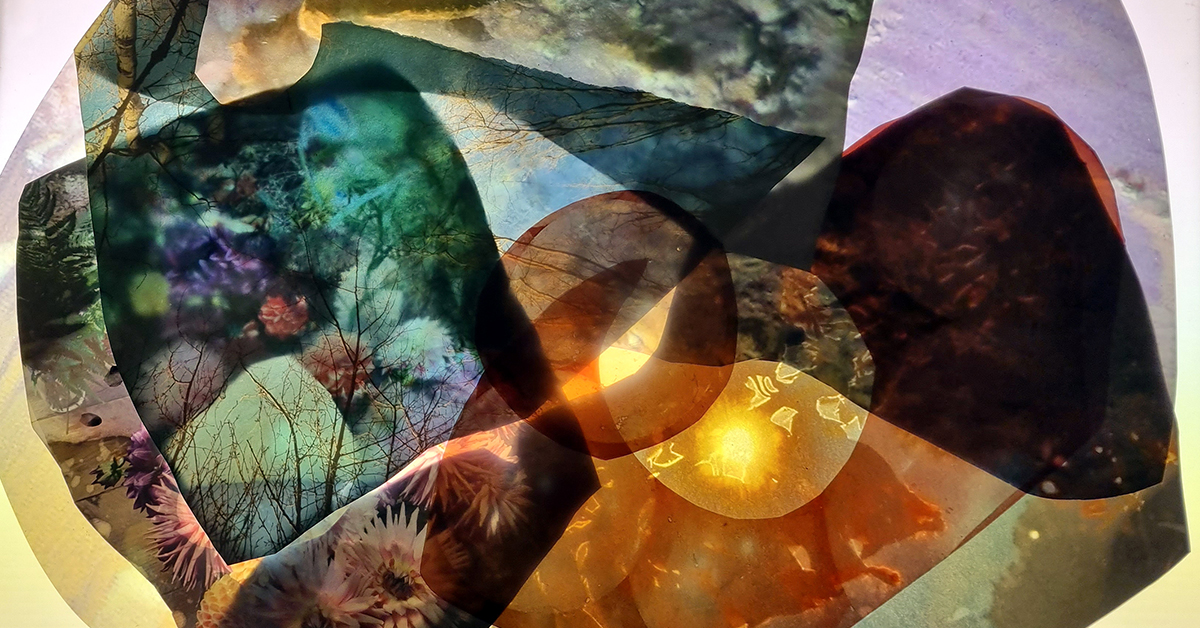

Header credit: ‘Seep (Swimming)’ 2021. Lightbox with c-type, giclee and duraclear prints, oil, watercolour and acrylic paint on paper. Alexandra Hughes. Courtesy the Artist
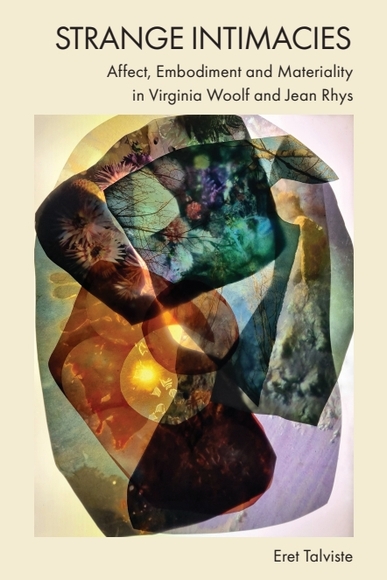
Strange Intimacies – Affect, Embodiment and Materiality in Virginia Woolf and Jean Rhys examines the life-affirming and enchanting aspects of Woolf’s and Rhys’s modernism with feminist, affect and new materialist theories.
by Eret Talviste
In Season 4 of The Handmaid’s Tale, Episode 4, ‘Milk’, there is a scene where Rita, after escaping from Gilead, sits by herself in her light-flooded kitchen in Canada, eats pre-prepared sushi, and opens a can of coke. The scene has stuck with me because it is a visual manifestation of scenes of similar feeling from Virginia Woolf’s and Jean Rhys’s fiction, written decades earlier than the given TV series and Margaret Atwood’s novel which is the inspiration for the series.
In Woolf’s Between the Acts (1941), Mrs Manresa, although not alone, enjoys coffee in resembling silence. In The Waves (1931) Susan loves her solitude on her farm on an early morning, thinking she is ‘the barn, the field’, ‘not a woman, but the light that falls on this gate’ (TW 70–71). In To the Lighthouse (1927), Lily’s biggest pleasure in life is painting alone. In Voyage in the Dark (1934), Anna remembers fondly how she loved the public spaces of her beloved island. In Wide Sargasso Sea (1966), young Antoinette sleeps and dreams outdoors by a pool. In After Leaving Mr Mackenzie (1931), Julia seems briefly happy when having a solitary drink at cloistered bar tables. All these scenes are seemingly ordinary and intimate, and yet, there is something extraordinary and strange about them.
What made me dwell on Woolf’s and Rhys’s writings in Strange Intimacies – Affect, Embodiment and Materiality in Virginia Woolf and Jean Rhys is scenes like these, which make up the narrative and the plot. These scenes, often situated in intimate and private spaces, are never just intimate and private. They speak volumes about the story-worlds, and worlds in which Woolf and Rhys, but also Atwood and the screenwriters imagined a woman being able to sit alone, undisturbed, enjoying a meal of her choice that she had the freedom to buy, not to prepare (for others).
Mrs Manresa sipping coffee on a June evening, Susan roaming the morning fields on her farm alone, Anna remembering public spaces of her beloved island, Antoinette sleeping and dreaming outdoors as a child, and Julia enjoying a drink, are all presumably daily activities. Yet, when contextualising these scenes within the larger forms and stories of these and other modernist novels, it appears that experiencing such moments has always been precarious because heteropatriarchal and imperial regimes monitor women’s bodies, and minority, non-normative bodies in ways that often exclude those bodies from experiencing even the simplest joys, both in private and public places.
Scenes like these, when woven into the larger narratives of the novels Strange Intimacies focuses on, show how feminist and posthumanist stances do not ask for extraordinary things. Rather, these theories ask for the ordinary to be possible and accessible to all. A woman should be able to roam the fields, eat a meal of her choice, sleep outdoors, drink alone in a bar. Significantly, the more-than-human world should be treated in a way that fields and meals remain accessible to all.
If I hadn’t spent such a long, intimate time researching Woolf’s and Rhys’s novels, reading them through contemporary affect and posthuman theories while bearing in mind older feminist theories, the moment in The Handmaid’s Tale would have not made such an eloquent imprint on my mind, because I would have not understood how fragile simplest freedoms are for women.
Drawing attention to contextual nuances is the power of literature and writing, as Hélène Cixous, one of the central thinkers studied in Strange Intimacies, writes:
[i]f one could x-ray-photo-eco-graph a time, an encounter between two people of whatever sex they might be, by some extraordinary means; and if one could consume the radiation of this encounter in a transparent sphere, and then listen to what is produced in addition to the exchange identifiable in the dialogue – this is what writing tries to do: to keep the record of these invisible events [. . .] all that will not have been pronounced but will have been expressed with means other than speech – that can be taken up in the web of writing. (Hélène Cixous and Mireille Calle-Gruber, Rootprints: Memory and Life Writing (Psychology Press, 1997), 48.)Strange Intimacies shows how Woolf’s and Rhys’s writings give form to certain affects that circulate in heteropatriarchal and imperial regimes in the abovementioned seemingly ordinary scenes, which are actually extra-ordinary in the sense that they should not be taken for granted. It is precisely in the written form that they reveal their strangeness and intimacy, and through that, also their significance.
Strange Intimacies shows how Woolf’s and Rhys’s writings give form to certain affects that circulate in heteropatriarchal and imperial regimes in the abovementioned seemingly ordinary scenes, which are actually extra-ordinary in the sense that they should not be taken for granted. It is precisely in the written form that they reveal their strangeness and intimacy, and through that, also their significance.

About the author

Eret Talviste is a researcher in English Literature at the University of Tartu. Her research interests include modernist and contemporary fiction, transnationalism, feminism, and posthumanism. Her first monograph Strange Intimacies – Affect, Embodiment and Materiality in Virginia Woolf and Jean Rhys was published with Edinburgh University Press in 2025.