



By Charles J. Stivale
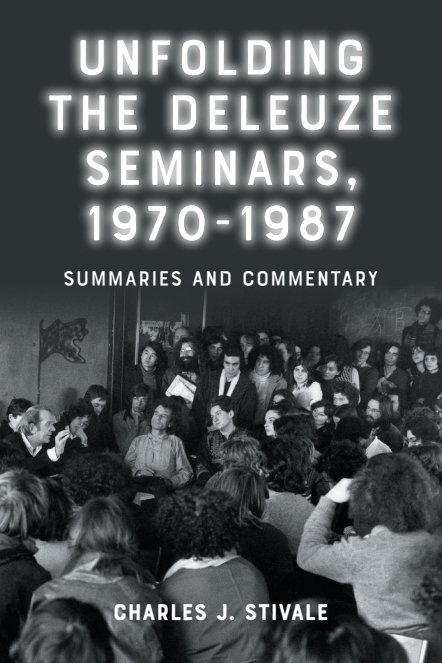
Charles J. Stivale is the author of Unfolding the Deleuze Seminars, 1970-1987, a rich resource of Deleuze’s research that is unavailable in his published writing.
I began reading Deleuze in the mid-1970s, after having discovered references to him in different essays and from a particular professor, Yves Velan, at the particular moment of this book’s translation into English. Of course, as a French scholar, I was expected to be able to master any text placed before me in the original French, but reading within a discussion group, I worked through the text by producing some of my first translations for the non-Francophone members, leading eventually to my first publications on Deleuze and Guattari. With these personal details, I suggest how this experience constituted a germinal moment in my engagement with Deleuze and Guattari. It certainly seems we’re now in a Deleuze ‘moment’, or perhaps a Moment, due in part to the energy and ambition of another scholar, David Lapoujade, as editor of successive collections of Deleuze’s occasional essays, interviews, reviews, correspondence, and even drawings, and now of definitive editions of Deleuze’s seminars. This work includes editing the original transcripts into a more manageable format with the goal of increasing the sessions’ readability and of providing footnotes and cross-references to many of Deleuze’s texts and other lectures.
Why does this constitute a Moment? Clearly, the appearance of apparently new texts from a well-known author like Deleuze always becomes an occasion for celebration. However, beyond the texts’ welcome by readers, this Moment arises through the array of publicity events and subsequent articles and general online buzz, followed by eventual translations and then additional articles and publicity and buzz.
To trace an initial timeline for this particular Moment, let’s first consider the pertinent books published by Éditions de Minuit in Paris:
- October 2023, Sur la peinture, cours, Mars-Juin 1981,
- October 2024, Sur Spinoza, cours, Novembre 1980-Mars 1981,
- October 2025, Sur les lignes de vie, cours, Mai-Juin 1980 as well as Sur l’appareil d‘État et la machine de guerre, cours, Novembre 1979-Mars 1980.
This apparent expansion of the Deleuzian corpus, perhaps not yet a Moment, did and does constitute a personal ‘moment’ given my ongoing work with the seminar transcriptions and translations for the Deleuze Seminars site. I’ve discussed this project and its complications in a talk with Dan Smith, ‘Archive Madness’, presented at the 2024 Delft Deleuze & Guattari conference, so I prefer to consider how these publications create a shift from something personally important to a Moment in a more substantial sense, an easy way for doing so being a Google search on each of these titles to reveal the publicity events online.
Furthermore, this publication Moment coincides, not by chance, with the centenary of Deleuze’s birth, suggesting the initiative to produce these volumes as part of a long view toward this current celebration. Of course, many media and cultural outlets have become involved in some important ways, notably, the upcoming week-long celebration at the Centre Pompidou, 3-9 November. I limit myself here to one outlet, France Culture, and its presentation of both archival and new programs for this Deleuze commemoration through a sophisticated online streaming platform. I can now add to the centenary timeline with what is the current Moment, throughout 2025:
In January, two distinct programs appear on ‘Les Nuits de France Culture’: the first is a repeat of a 2002 program titled ‘Deleuze Variations’ produced by Claire Parnet, an extraordinary mix of recordings of Deleuze (two that are currently unavailable, privately recorded by Parnet, plus excerpts from the Abécédaire and from the Cinema 3 seminar) and comments by different Deleuze scholars (Clément Rosset, Pascale Criton, Richard Pinhas). The second program is a four-minute profile of Deleuze by Mathias Le Gargasson, with Le Gargasson also adding five different programs from the recording archives, including from 1956, a 31-year old Deleuze discussing David Hume (the subject of his first book), and his talk ‘Spinoza et nous’, an early version of the conclusion to his 1981 Spinoza: Practical Philosophy.
In February, France Culture’s ’Avec Philosophie’ focused on ‘Que faire de L’Anti-Oedipe de Deleuze et Guattari?’ [What to do with Deleuze and Guattari’s Anti-Oedipus?]
In the first episode, David Lapoujade’s discussion of Anti-Oedipus with Géraldine Muhlmann is accompanied by added readings from the text as well as commentary by different philosophers; the second episode’s topic is on Anti-Oedipus and psychoanalysis, the third is a ‘Manifesto for a non-fascist life’ (the description of Anti-Oedipus by Michel Foucault); and the fourth episode focuses on interrogating ‘Colonial Oedipus?’
In March, the only new recording is the brief but tantalising broadcast ‘Understanding Deleuze in 3 Minutes’, that is, ‘three concepts to understand Deleuze’s thought’: the concept of ‘concept’ itself understood as a tool to create philosophy; another one, the ‘desiring-machine’; and third, the concept of ‘becoming’.
In May, France Culture’s ‘Le Souffle de la pensée’ [The breath of thought] offered a personal and professional appreciation of Anti-Oedipus by Christophe Claro, in dialogue with the host, Géraldine Mosna-Savoye, on this book’s impact on his life, from age 18, along with A Thousand Plateaus.
In June, under the publicity banner ‘Centenaire Deleuze’, we find a four-part series about A Thousand Plateaus, with the topics ‘Make your rhizome!’, ‘The War Machine’, ‘Becoming-intense, becoming-animal, becoming-imperceptible’, and ‘The Ritornello’, four themes providing an overview of much of A Thousand Plateaus.
At mid-year, starting in July, France Culture and David Lapoujade have offered the phenomenal series of seminar recordings by Deleuze, with the title: ‘Deleuze retrouvé, 16 leçons de philosophie’ [Deleuze rediscovered, 16 lessons in philosophy], consisting of excerpts from juxtaposed Deleuze seminar recordings, linking A Thousand Plateaus to each of the subsequent plateaus, from Spinoza through cinema and Foucault to Leibniz and the Baroque. To assist readers in accessing this initiative, a page linked to the Resources menu of the Deleuze Seminars site now provides the French transcripts and English translations of all the excerpts selected for these lessons.
I’ve come to realise that the title of this post should read instead ‘How Does a Moment Work?’ Since my own germinal moment, I have considered the ebbs and flows of larger cultural Moments. From the 1970s onward in the Anglophone world, under the influence of what was called ‘French theory’, a tidal wave of translations flowed forth, and in some ways, the Deleuze-Guattari translation gap in the 1980s explains why their influence ebbed significantly in contrast to the flow of works by Derrida and Foucault, to name just two. Within this conjuncture and somewhat illogically, I pursued a career within their ebbing current, during which a shift occurred in the 1990s and 2000s — increasing conferences, global contacts through the internet and then World Wide Web, and an entire industry of translations – toward the more recent Deleuze camps, conferences and journal publications.
I’ve been asked whether anyone at any moment can really sense either form of moment/Moment, so given my use of this term, I need to nuance it considerably. While experiencing a meaningful germinal ‘moment’ back in the 70s, I certainly did not conceptualise my graduate student experiences as part of a Moment. My awareness of shifts in the French theoretical field (from structuralism per se and into its subsequent multifaceted critique) was at best confused. On the other hand, more recent work on the Deleuze Seminars site since 2018 became another personal moment given my focus on successive translations, conferences, and research initiatives linked to this project. In turn, this personal moment indeed connects to the ongoing larger Moment, notably the French initiative to reassert Deleuze’s importance in a country that in many ways has neglected him, with the Pompidou Centre’s homage to Deleuze as something of the crowning event.
In other countries, cultures and contexts, the notion of Moment necessarily presents entirely different contours. I’ve suggested the importance of translations within particular language groups to contribute to an author’s Moment, and I suggest Argentina as an example after having presented these remarks via Zoom at a conference at the Pontificia Universidad Católica in Buenos Aires. Although I lack the full picture of Deleuze-Guattari translations in Spanish, the first two volumes of seminars published by Minuit, Sur la peinture and Sur Spinoza, already are part of the translations published in Buenos Aires by Equipo Editorial Cactus, Pintura: el concept de diagrama (2007) and En Medio de Spinoza (2008). One of the just published volumes, Sur l’appareil d’État et la machine de guerre, was published in 2017 as Derrames II. Aparatos de estado y axiomática capitalista. In other words, one Argentinian editor needed no centenary to celebrate the Deleuze seminars, starting in 2005 with Derrames I. Entre el capitalismo y la esquizofrenia, thereby establishing productive lines of research on Deleuze and Deleuze-Guattari while also appreciating their works as ‘momentous’.
Moreover, as David Lapoujade has intimated in different interviews, Cactus in Argentina, along with the Italian press, Ombre corte in Verona, Italy, are at least partially responsible for the seminar series now in print from Minuit, evident from Lapoujade’s 2023 interview with the Librairie Mollat. Thanks to these presses, Cactus and Ombre corte, and to the altogether valid desire for access to Deleuze’s teachings in Spanish and Italian, Lapoujade felt it advisable to produce the ‘definitive’ French versions now in development, apparently on an annual basis. Hence, I suggest that while no definitive answer to the question ‘what’s in a moment?’ is possible, the Moment’s constitutive production is evident in what has been created in the wake of this Deleuzian tidal wave that seems unending, and in what we ourselves are able to create moving forward, as an ongoing form of celebration.

About the author
Charles J. Stivale is Distinguished Professor Emeritus of French at Wayne State University, Detroit. His books and journal articles are in nineteenth and twentieth-century French Studies and on Deleuze and Guattari, most recently, Gilles Deleuze’s ABCs: The Folds of Friendship (Johns Hopkins University Press, 2008). He has translated or co-translated The Logic of Sense (with Constantin V. Boundas and Mark Lester; Columbia University Press, 1990, Bloomsbury, 2015), Félix Guattari: Thought, Friendship, and Visionary Cartography, by Franco Berardi (Bifo) (with Giuseppina Mecchia; Palgrave-MacMillan, 2008), Deleuze and Claire Parnet, Gilles Deleuze, From A to Z (DVD, MIT Press/Semiotext(e), 2011), Deleuze On Painting and Deleuze On Spinoza (with the Deleuze Seminars Translation Collective; University of Minnesota Press, 2025 and forthcoming). He serves as co-director with Daniel W. Smith of The Deleuze Seminars.