

By Ana Balda
Ana Balda is the author of ‘Wladzio D´Attainville and the House of Balenciaga (1924–1948)‘ in issue 60.1 of Costume.
1. Tell us a bit about your article
The article looks at the figure of Wladzio D’Attainville, a name that frequently appears in studies on Cristóbal Balenciaga but has so far been little explored. Its aim is to reconstruct his profile and to place his presence within the couturier’s career.
2. What inspired you to research this topic?
I have been researching the House of Balenciaga and the figure of the couturier since I began my doctoral thesis more than sixteen years ago. Throughout this time, the name of Wladzio D’Attainville has appeared repeatedly and inevitably in any study of Balenciaga and on several occasions I considered researching him in greater depth. However, there were always other research priorities that seemed more urgent.
The decisive moment came in 2021, when it was announced that Disney was working on a series about Balenciaga. It was clear that D’Attainville would play a prominent role and that the narrative of the ‘lover’ would become a central element from both a storytelling and a marketing perspective, as indeed proved to be the case. At that point, I realised that the series would spark renewed interest in the character, and I was concerned to find that, from an academic standpoint, we knew very little about who he actually was. In fact, even his nationality had not been firmly established.
3. What was the most exciting thing about this project for you?
Discovering that we actually knew almost nothing, and that the information was there, simply waiting to be found. Those of us who work in research are well acquainted with long, arid days of fruitless searching, as well as with the moment when, instead of giving up, you decide to persist and, suddenly, a document appears that changes everything and leads you to an oasis. That moment is deeply satisfying.
The key discovery was his military card. I had previously worked at the Archives de Paris while researching Vionnet and Balenciaga, an archive with a vast amount of digitised material. It was one of the first collections I consulted, in the spring of 2022 and the search proved fruitful. From that initial document, I began to piece together the puzzle.
4. Did you discover anything particularly strange or surprising?
Yes. First, the discovery of his family connections, which linked him to the highest levels of French, Spanish and British aristocracy. And second, the confirmation that he was already in San Sebastián working with Balenciaga in 1924—an absolutely pivotal year in the early history of the House of Balenciaga.
5. Did you get exclusive access to any new or hard-to-find sources?
Rather than having exclusive access, I would say it was an especially labor-intensive piece of research. Searching for his surname in the Spanish and French press proved exhausting: in many cases no results appeared because his name was frequently misspelled.
In addition, the support of the staff at the San Sebastián City Archives was essential, something I would very much like to emphasise and acknowledge. When information has not been digitised, the expertise and commitment of those who work in archives are absolutely crucial to the progress of research.
6. Did your research take you to any unexpected places or unusual situations?
Yes, without a doubt. I suspected that D’Attainville was a socially significant figure, but it was a real surprise to discover the extent of his connections with the highest European aristocracy of the time.
I also found his two-and-a-half-year stay in Berlin particularly interesting. This helped me better understand how Balenciaga was able to sell in Zurich—a German-speaking city—during the years of the Second World War: he had an excellent interpreter and intermediary.
7. Has your research in this area changed the way you see research in fashion?
I would not say that it has changed my perspective radically, but it has certainly reinforced a fundamental idea: narratives are narratives, and evidence is something else. We should not treat narratives as established truths.
Now that we have increasing access to digitised sources, it is essential to practise intellectual honesty and to approach research without inherited preconceptions that we often carry unconsciously. Just as this article shows that Wladzio was key to the early years of the House of Balenciaga, it is worth asking which other figures—now largely invisible—were essential to the success of other luxury brands. That ‘second row’ is particularly compelling from a research perspective.
8. What’s next for you?
I continue to research Balenciaga’s early period in Spain, a phase that remains less well known, largely because the available sources are scarcer or more challenging to work with. Even so, I am making steady progress, and I hope that the results will soon take shape in a publication and/or an exhibition.
About the author
Ana Balda is a researcher and academic specialising in Fashion History and Visual Communication. She holds a degree in Economics and Business Sciences and a PhD in Communication. Her research centres on the business and cultural aspects of fashion, with a particular focus on the work of Cristóbal Balenciaga. She has published in leading journals such as Fashion Theory, International Journal of Fashion Studies and Costume and is co-author of Balenciaga — Kublin: A Fashion Record (Thames & Hudson, 2024). She has curated exhibitions on the Basque designer, collaborates with the Balenciaga Museum in Getaria, and advises public and private institutions. Since 2013, she has taught Fashion History and Fashion Illustration and Photography at the Communication Faculty of University of Navarra.

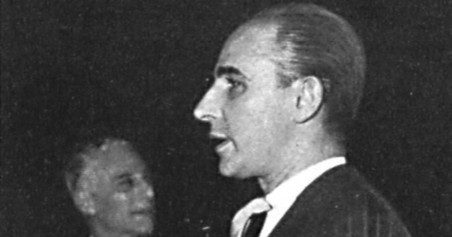
Featured image: Wladzio d’Attainville at a meeting of the Swiss textile sector (Textiles Suisses, 1948, p. 54).