
by Charlie Ellis

Scottish Affairs, ‘Declinism, Urban Discourse, and Fertile Ground for the Radical Right in Scotland.’
‘It’s in anarchy’
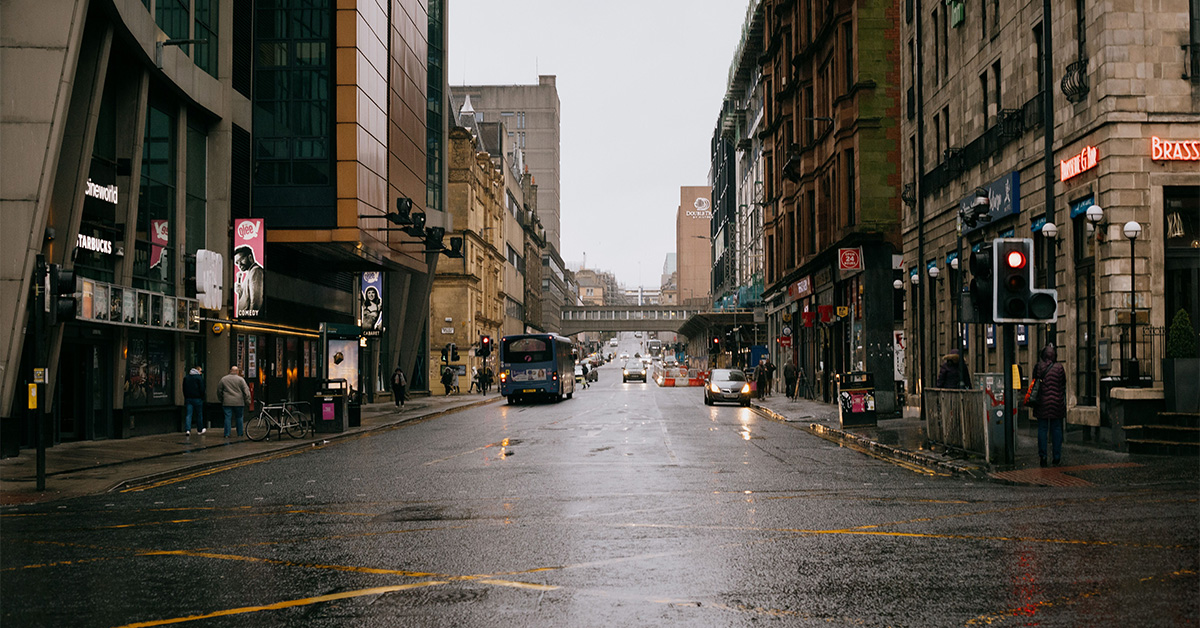
One of Reform’s new MSPs, Thomas Kerr, recently caused a stir when he described Glasgow’s city centre as ‘lawless.’ The ‘state of’ the city centre, he said, had been the ‘biggest issue’ he’d been contacted about since becoming an MSP in May. The consensus among those who’d been in touch was that the city was ‘in decline,’ increasingly ‘lawless,’ and that ‘it’s in anarchy.’
The video illustrating a city ‘on the down’ certainly featured groups with brown and black faces. His litany of issues, spotted on a thirty-minute walk through the city centre, included ‘four migrants staring at a young girl’ (around fifteen years old), ‘large groups of men hanging about,’ ‘a drug deal,’ and people taking drugs.
Critics countered that Kerr was politicising and weaponising genuine issues, tying a perceived decline directly to immigration. His walkabout video, they pointed out, documented no actual criminal acts, just an overflowing bin and groups of non-white residents standing in public places, and local crime statistics don’t support his claims of a ‘crime epidemic.’ In short, there’s broad agreement that Scottish urban centres aren’t as healthy as they might be, but no agreement at all about why.
Kerr isn’t a lone voice. A few months ago, veteran broadcaster Andrew Neil delivered his own verdict on Glasgow, calling the decline of Sauchiehall Street a ‘shambles and a disgrace to Scotland’s biggest city’ and a ‘national scandal.’ Visiting for the first time in over a decade, Neil voiced his ‘anger and indignation’ that a street which ‘used to be world-famous, Glasgow’s equivalent of Oxford Street’ had become a ‘ghost of its former self,’ and turned his fire on the city administration, arguing Glasgow City Council should be ‘put into administration’ for being ‘clearly incapable of running a proud city.’
Neil isn’t a Reform figure, and his complaint was narrower than Kerr’s: retail decay and council incompetence, not crime and demographics. But the two interventions, arriving close together, show how readily the same image of urban failure crosses political lines. Kerr’s ‘lawlessness’ and Neil’s managerial incompetence are different diagnoses of the same symptom: a shared sense that Scotland’s cities are falling apart.
Kerr’s remarks land amid heightened tensions and community protests in wider Glasgow areas like Cranhill, Castlemilk, and Possilpark. While angry confrontations at ‘asylum hotels’ are the most visible manifestation of the radical right’s rise, the incursions are often much lower-key. Debates about the state of our urban centres are one of the key spheres where that potential is becoming clear.
‘So relatable’
As Jim Armitage of The Sunday Times observed on Times Radio (9.11.25), hard-right figures such as Richard Tice have ‘alighted’ on urban decline because it is ‘so relatable,’ it resonates precisely because people feel it, viscerally, every time they walk down a high street that used to mean something. That emotional charge, Armitage noted, is ‘how angry it is making people feel,’ and it feeds a broader sense of social malaise that isn’t reducible to any one cause.
He argues mainstream parties have failed to engage with the issue and have effectively ‘left it to the hard right,’ who point to the proliferation of ‘vape shops, barber shops and grubby mini-marts’ as definitive proof of decline. The growing political salience of the topic is captured in the title of Armitage’s own piece, ‘Why the next election will be fought on our corrupted high streets’, and in the session devoted to it at Reform UK’s 2025 conference: ‘Revitalising the Great British High Street, how to reverse decades of decline.’
The counter to charges of racism, voiced by figures including the editor of The National, is that liberal progressives are in denial about what’s actually happening in Scottish urban places, that they live somewhere insulated from it, or simply refuse to see it. For Kerr, ‘the political establishment’ doesn’t ‘want to hear’ what ordinary people in the city are experiencing, because it doesn’t fit their progressive, multicultural agenda. Underneath all this sits a deeper assumption: that the radical-right politics Kerr and Reform represent is something alien to Scottish political culture, a country often described as sitting to the left of its English counterpart.
Fertile ground for the radical right?
These are the themes I explore in an article in the August 2026 edition of Scottish Affairs, ‘Declinism, Urban Discourse, and Fertile Ground for the Radical Right in Scotland.’
The article examines the ideological currents embedded in contemporary discourse on urban decline, and asks what these narratives reveal about the conditions under which Reform UK and other radical-right populist actors, such as Rupert Lowe’s new Restore Britain, may find fertile ground in Scotland: a country long assumed resistant to such forces. The weaponisation of nostalgia and urban grievance by the radical right is a phenomenon found in many countries. In that sense, Scotland may not be as exceptional as it’s sometimes portrayed.
About the author
Charlie Ellis is a researcher, writer and EFL teacher based in Edinburgh. He writes on culture, politics, specialty coffee, sport, and education, and is a regular contributor to Scottish Affairs, Society, Modern English Teacher and a variety of Scottish publications including Bella Caledonia, Sceptical Scot, and The Leither.