


by Kelly Staples
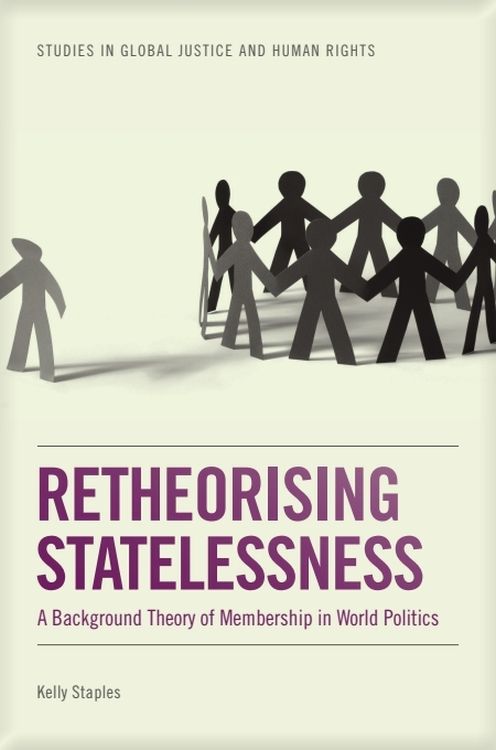
Retheorising Statelessness applies international political theory to statelessness as an ethical and political concern
What does it mean to be state-less? Does not being considered as a national by any state in the world result in an other-worldly form of exclusion, or might we consider such people to be a type of ‘world citizen’? In Retheorising Statelessness, now out in paperback, I try to answer these questions, and to rethink the potential of world citizenship for people excluded – by accident or by design – from their states, and hence from the international society of states.
United Nations data reports that there are ‘at least 4.4 million stateless people worldwide’. Nobody knows how many people are actually not considered to be nationals of any state. Indeed, it is extremely unlikely that there will ever be any reliable way to measure statelessness. Even so, statelessness is increasingly being noticed by governments, non-governmental organisations, the UN, and by researchers interested in membership in world politics.
Viewing world politics from the perspective of statelessness highlights the complexity of being recognised as a person. While having a nationality is generally easy to demonstrate, proving statelessness can be almost impossible. Attention to statelessness also shows us that nationalities are not solid possessions or attributes. Instead, questions of citizenship are political in various ways. Even people who seem straightforwardly to fit the criteria set down in the nationality laws of a given state can sometimes sensibly be deemed to be stateless. Decisions over whether or not a particular person or group of people should be considered citizens can be petty, bureaucratic, and discriminatory, and are often invisible to outside actors.
These distinctly political aspects of being stateless have led to attempts by scholars and interested organisations to come up with terms like ‘de facto statelessness’ and ‘ineffective nationality’. These labels suggest that a person can hold a nationality that does not work properly; that is faulty or broken. The benefit of this way of thinking about statelessness is that it resists the negligent (at best) and deliberate (at worst) negation of a person’s claim to citizenship. On the other hand, the obvious downside of not recognising statelessness can be preferring what Paul Weis called ‘legal fiction’ to social fact.
Attempts to reduce statelessness have increased exponentially in recent decades, partly in recognition of its complexity and political inevitability. In 2014, for example, the UN set out its Global Action Plan to End Statelessness, and Agenda 2030 includes the goal of legal identity for all. However, the powers over citizenship retained by the state loom large over such plans, which depend on the same state governments often responsible for statelessness. What is more, the international drive for ‘legal identity for all’ risks further marginalising those left without it, highlighting the prescience of Hannah Arendt’s 1951 claim that ‘only with a completely organised humanity could the loss of home and political status become identical with expulsion from humanity altogether’.
Is global citizenship the response to statelessness?
Arendt, who was, for a time, stateless herself, saw little hope in the potential for ‘the rights of man’ to resolve this outcast phenomenon. Today, however, it is often argued that the development of international human rights brings the stateless person into the ambit of world society, humanity, or global citizenship.
Theorists of world politics critical of the enduring state power over legal personality have often argued for a model of human ‘state-freeness’. Cosmopolitan theories assume or argue that the relevant moral and political community is the globe, not the nation-state. In the late twentieth and early twenty-first century, a revitalised debate about cosmopolitanism took hold in political theory. In recent decades, however, hopes for effective cosmopolitan institutions seem to have dimmed in recognition of the stubbornness of state sovereignty as a foundational practice of world politics. My book also provides troubling examples of groups of human beings whose status was degraded considerably by international challenges to state powers over the citizenship question.
Where does this leave those of us concerned at what it means to be outside of organised society? Are we to abandon all hopes that being human can be made to carry moral and political weight? The book also suggests (cautiously) that neither resignation (nor despair) are our only options.
Retheorising statelessness
Taken together, the residual state interest in sovereignty over nationality, the complex practical realities of state responses when citizenship is in question, and the continuing limits to the human/rights relationship do paint a sobering picture. And yet, the political character of personhood can also be a condition of possibility. Recent innovations in the study of statelessness have – in various ways – cautioned against seeing statelessness as equivalent to a total ‘expulsion from humanity’. The practical limits to particular nationality laws, and to global anti-statelessness norms, simultaneously allow marginalised people to claim statelessness as a status. Although this status is limited, its recognition at all levels reinforces the moral and political importance of the human, set apart from citizenship. We can but hope that this political space is leveraged against the continued attempt to stick personhood to citizenship.
About the author
Kelly Staples is Associate Professor of International Politics at the University of Leicester, and author of Retheorising Statelessness: A Background Theory of Membership in World Politics as well as other chapters and articles on statelessness and citizenship.