

By Pejman Firoozbakhsh and Arezou Azad
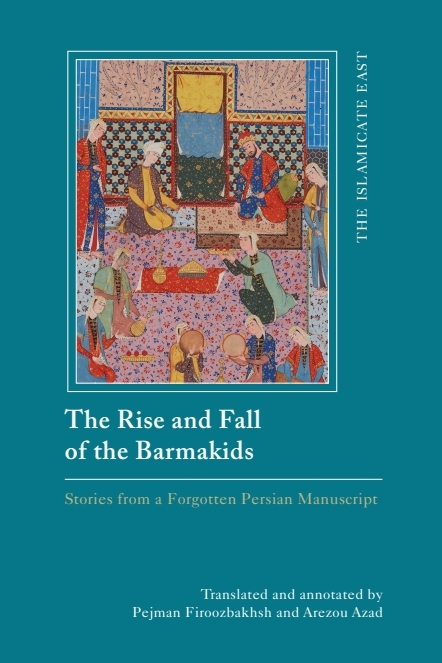
This translation of a medieval Persian story cycle adds new perspectives to Abbasid history, Delhi sultanate history, global history and world literature.
Tell us about the Barmakids.
The Barmakids were among the most prominent families to rise within the early Islamic empire. Their roots lay in Balkh, in present-day northern Afghanistan, where their ancestors served as barmaks—administrators of the influential Buddhist monastery of Naw Bahār. Supported by extensive agricultural estates across the Balkh oasis, they effectively governed this prosperous region before the Muslim conquests.
After Balkh’s fall to the Umayyad general Qutayba b. Muslim in the early eighth century, a barmak and his son were taken to the Umayyad court, where they became clients to the Umayyad elite. His son, Khālid b. Barmak, later played a key role in the Abbasid revolution and became renowned for his administrative abilities. Khālid’s son Yaḥyā, raised at the Abbasid court and serving as foster-father to the future caliph Hārūn al-Rashīd, emerged as one of the most powerful figures of his time. Yaḥyā’s sons Faḍl and Jaʿfar also reached high office, and the family became known for their generosity, learning and patronage, including their role in the transmission of works from India, such as the Panchatantra, which became known in the Islamic world as Kalīla wa-Dimna.
Why do the Barmakids continue to attract attention?
Their sudden fall in 803—when Hārūn ordered Jaʿfar’s execution and imprisoned Yaḥyā and Faḍl—turned them into figures of enduring fascination. Their rise and dramatic downfall were retold for centuries in Arabic and Persian sources, and later entered European literature and imagination.
What is the text translated in this volume?
The work, Akhbār-i Barmakiyān, is a Persian collection of tales about the family. Although attributed to the Delhi Sultanate historian Ḍiyāʾ al-Dīn Baranī, it reflects earlier Arabic materials that have not survived. It forms part of a wider Persian tradition that reworked Arabic narratives for new audiences.
The manuscript known as Ouseley 217, now at the Bodleian Library in Oxford, is one of the earliest witnesses to this Persian recension. It offers valuable insight into how the Barmakids’ story was preserved, adapted and reimagined across different regions and centuries.
Why is this book important for historians of the Islamic world and for global literature?
This volume makes accessible, for the first time in English, a richly layered corpus that bridges history, storytelling and cultural memory. For historians, it provides a rare Persian reworking of early Arabic traditions about the Barmakids—allowing us to trace how their rise and fall were understood across regions and reshaped over time. It also illuminates the political imagination of later periods, showing how the Barmakids became models of wise governance, generosity and moral exemplarity.
For global literature, the collection reveals the narrative world from which the One Thousand and One Nights later drew. Its tales of courtly intrigue, moral testing, romance and reversals of fortune belong to a shared transregional repertoire that circulated from the Middle East to Europe. Translating this text opens a window onto the movement of stories across languages and cultures, and helps situate the Barmakids within a broader literary and storytelling tradition that has shaped world literature.
Can you summarise one of the stories for us?
An especially poignant interchange is described in Story 67, where, following Hārūn’s execution of Jaʿfar Hārūn, Hārūn quizzes ʿĪsā b. Shāh Fīrūz (formerly Jaʿfar’s protégé). Here ʿĪsā b. Shāh Fīrūz assures the caliph of Jaʿfar’s faithfulness, going so far as to say that even when told of Hārūn’s plot against his life, Jaʿfar maintained that ‘By the God of the Kaʿba, if Hārūn al-Rashīd ordered my dismemberment and crushed me into little pieces, I would still not forget the good things he has done for me, nor would I ever betray him or wish any evil upon him or his children!’ Hārūn is deeply moved by what he hears, wailing and lamenting, before reinstating ʿĪsā b. Shāh Fīrūz as a wine steward and declaring ‘You’ve proven yourself a true friend to Jaʿfar and have given me hope that you will do the same for me!’
About the authors
Arezou Azad is Senior Research Fellow and Director of the Invisible East programme at the Department of Continuing Education at the University of Oxford. She is also Professor and Chair of the Arts and Heritage of Afghanistan at the Institut national des langues et civilisations orientales (Inalco) in Paris. She has authored three other peer-reviewed books: The Warehouse of Bamiyan (Edinburgh University Press, 2026), Faḍāʾil-i Balkh (The Merits of Balkh), an annotated translation of a 13th-century history of Balkh (Edinburgh University Press, 2021) and Sacred Landscape in Medieval Afghanistan (Oxford University Press, 2013).
Pejman Firoozbakhsh is a postdoctoral researcher at the Asia and Africa Institute at the University of Hamburg. Pejman is principally interested in the formation and development of early New Persian, West Iranian dialects, Persian codicology and textual criticism. His award-winning monograph is Fahlawiyāt: Pazhūhishī dar ashʿār-i bāzmānda az zabān-i adabī-yi mushtarik-i ʿIrāq-i ʿajam wa Ādharbāyjān (Tehran: Intishārāt-i Duktur Maḥmūd Afshār, 2023).

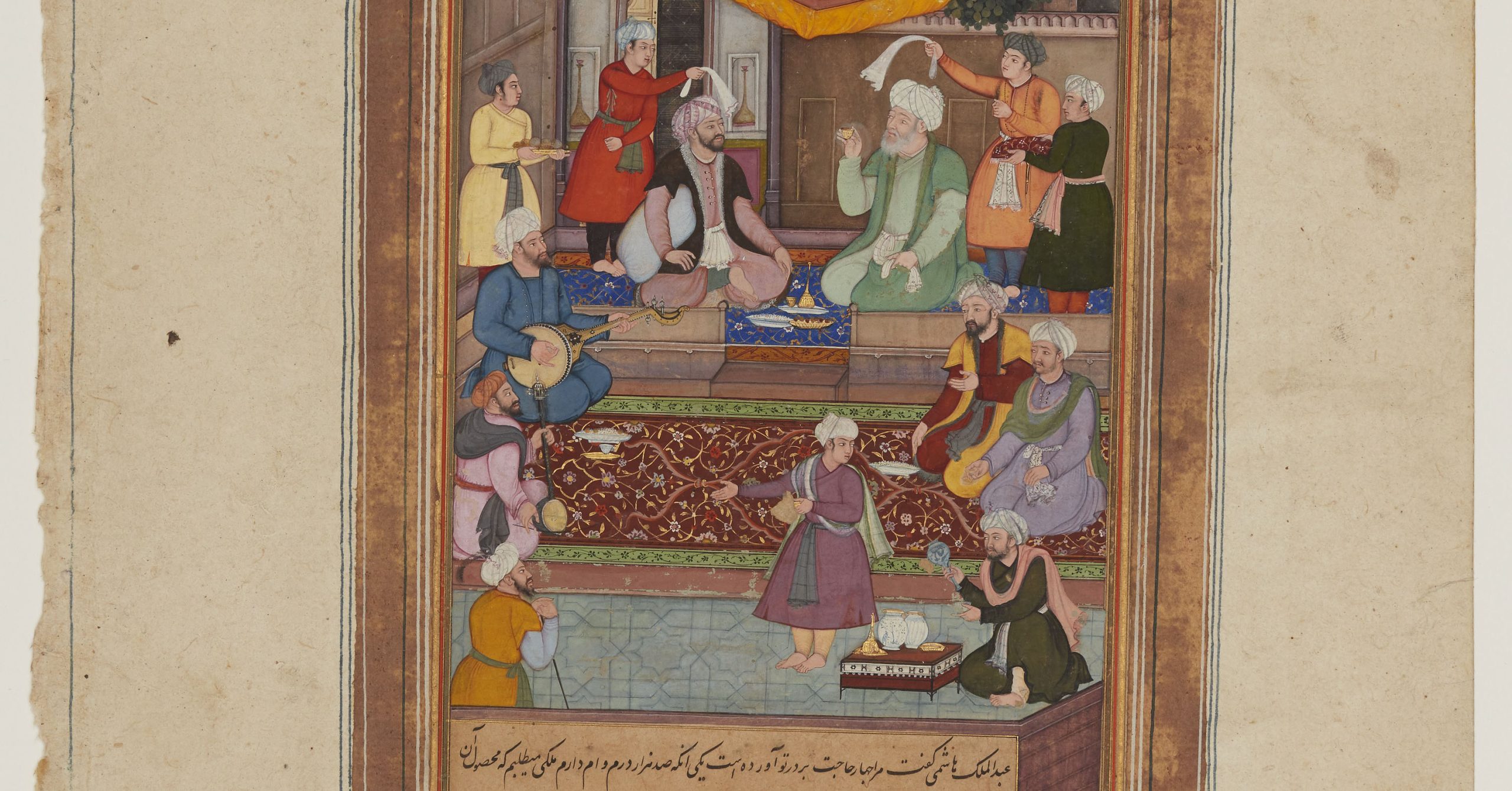
Featured image: ʿAbd al-Mālik al-Hāshimī and Jaʿfar discuss matters at the party. Ḍiyāʾ al-Dīn Baranī, Akhbār-i Barmakiyān. The Aga Khan Museum, AKM 126. Reproduced by permission from the Aga Khan Museum.