


By Margaret Mullet
Margaret Mullet is the author of ‘Advising the Byzantines: the pervasiveness of parainesis’. Read the article for free in issue 5.1 of the Journal of Late Antique, Islamic and Byzantine Studies.
Apparently, we all do. The Irish Times proclaimed recently that ‘we live in an age of peak advice’. In 2019 the Guardian noted, under the headline ‘Stressed Brits buy record number of self-help books’, that Nielsen Book Research reported a rise of 20% in advice literature of this kind. The author explained this phenomenon in terms of political uncertainty—and this was before the pandemic and the 2024 American election. In 2009 the brilliantly entitled Never Kiss a Man in a Canoe (spoiler: nothing to do with the dangers of capsizing) inspired a flurry of articles about agony aunts, from the beginnings in 1691 with John Dunton’s Athenian Gazette to the golden age of Marje Proops and Claire Rayner. And this is still current. We still read How to Win Friends and Influence People; we cannot throw out Marie Kondo. Nor is all this popular advice strictly contemporary. Machiavelli’s The Prince has never gone out of fashion, and there is a great readership for Sun Tzu’s Art of War, both applied to corporate striving. There is a recent fondness for the Meditations of Marcus Aurelius: Rory McIlroy admits to going home after a bad day at the Ryder Cup and communing with the Stoic emperor.
Byzantine advice literature
Byzantine (CE 330-1453) advice literature (parainesis) has not attracted twenty-first-century readers in the same way, but it is a far from negligible body of material. From how-to manuals on war, agriculture, diplomacy and ceremony to self-improvement texts on virtue and choosing a good wife, anxious queries (with answers) about abstinence from sex to warnings not to eat mushrooms or have a friend to stay (he will seduce your wife, or at least claim he has, and throw it in your face in battle), there is a great deal of it.
A journey to advice
I never intended to work on advice, though I have engaged with three eleventh- and twelfth-century works of this kind: Kekaumenos’s Admonitions and Narrations for studies on friendship and story-telling, and Theophylact of Ochrid’s Paideia Basilike for work on imperial image, on criticism veiled as praise and on teacher-pupil relations. I also looked at the Alexian Komnenian Muses for concepts of inspiration, then for the insights of dynasty. But as advice, no. And then I was asked to speak at the retirement of Professor Crow, friend and colleague in the booming subject of Byzantine Studies at the University of Edinburgh. Advice seemed the sort of thing to try (I am always complaining that no one trains us to retire), especially when I discovered that fables were intricately connected to Byzantine advice and there are a lot of crow fables…
Things I learned
Advice affinities
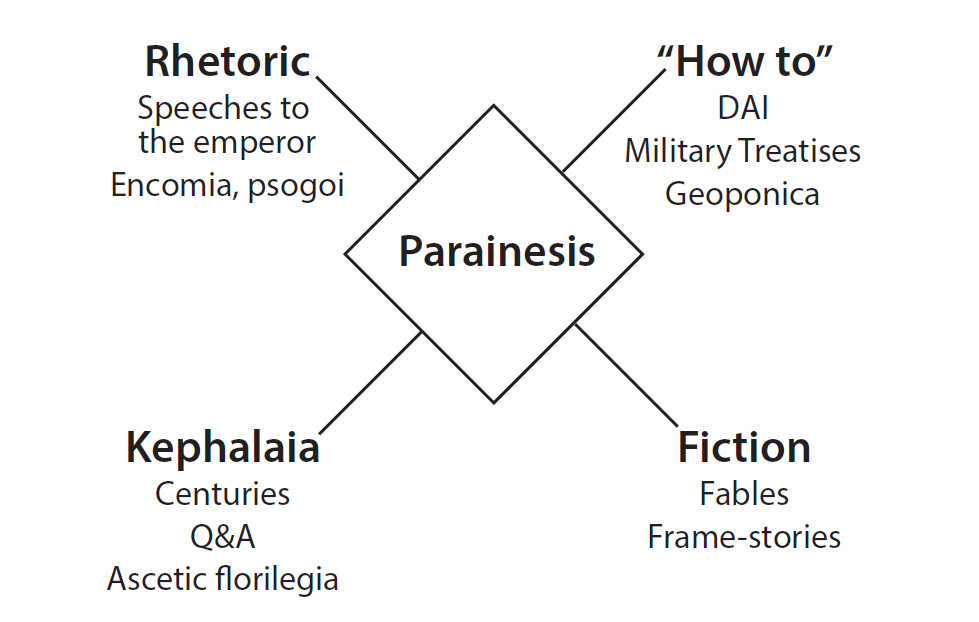
- Advice in Byzantine Greek is not a single genre. Work by two young scholars I greatly respect, Florin Leonte and Giulia Maria Paoletti, seems to occupy different worlds, the one looking at the interface between rhetoric and advice, the other at late Byzantine vernacular poems. For me their texts were indisputably related by the process of giving and listening to advice, not by form; advice is a mode not a genre. Nor is there a genre of ‘Mirrors for Princes’ in Byzantium. In both medieval west and Islamic east the quintessential advice literature was advice to a ruler. But in Byzantium a classic scenario is visits to a holy man, and we also have advice from a pastor to his congregation, a high cleric to his ruler, a spiritual father to a spiritual son, a patriarch to a foreign ruler, a rhetor to the emperor’s subjects, an empress to her son, a retired soldier to his sons, toparchs, emperors. These texts have far more in common with each other than differences.
- Advice is connected to speeches of praise but also to ‘how-to’ treatises and edifying collections of stories and maxims. It can be found in poems, speeches, treatises, chapters with acrostics, Q&As and letters; histories and hagiographies show us advice being given and (sometimes) acted upon. It is also connected to fiction, both the short-form fable and the long-form frame-story which, though trialled in the tenth century, came into Byzantium in the eleventh century, translated from Georgian (Barlaam), Syriac (Syntipas) or Arabic (Stephanites).
- Advice differs from didactic because it commands action rather than learning facts, from protreptic because it urges the advisee to continue in a way of life not take up a new one, from symbouleutic (possibly) because it involves general already-known truths not specific time-specific counsel.
- Advice literature tells us about contemporary society but can also change it. As with agony aunts and self-help literature, Byzantine advice literature reflects the concerns and anxieties of those who solicit the advice and also tells us about who advised. Proops campaigned for contraception, gay rights, sex education; Byzantine authors adjusted norms and projected ideals.
- Advice was pervasive in Byzantium– and perhaps far beyond. They all, we all, need advice.
About the author

Margaret Mullett, OBE is Honorary Professor in the School of History, Classics and Archaeology at the University of Edinburgh. She was trained at Birmingham, taught at Queen’s University Belfast for 35 years, then became Director of Byzantine Studies at Dumbarton Oaks, Harvard’s research centre in Washington DC. She has held visiting positions at Vienna and Uppsala. She works on the borderlines of history and literature, originally on letters but has progressed to rhetoric, hagiography, lament, drama—and advice. Her ‘Advising the Byzantines: the pervasiveness of parainesis’ is available to read in issue 5.1 of the Journal of Late Antique, Islamic and Byzantine Studies (2026).
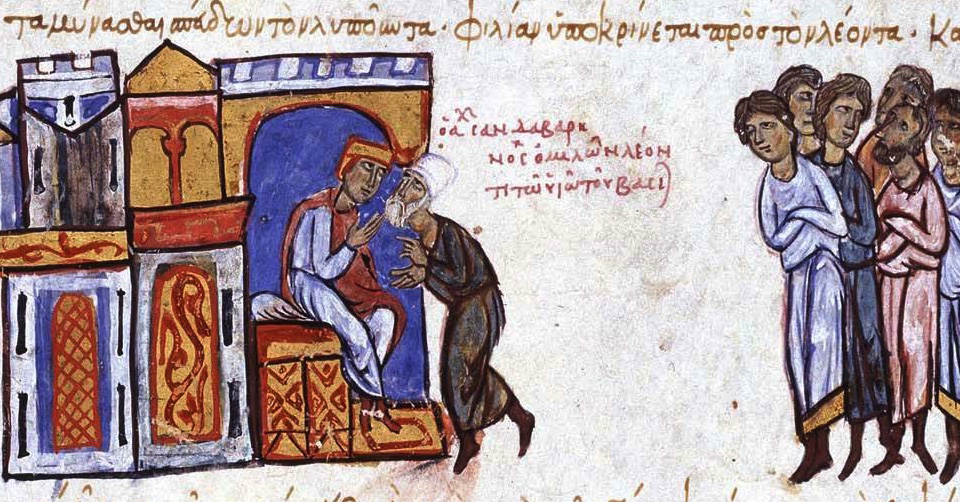
Featured image: National Library, Madrid: Cod.Vitr. 26-2, fol. 104v top: The monk Santabarenos advises the future Leo VI