

by Anna Marta Marini
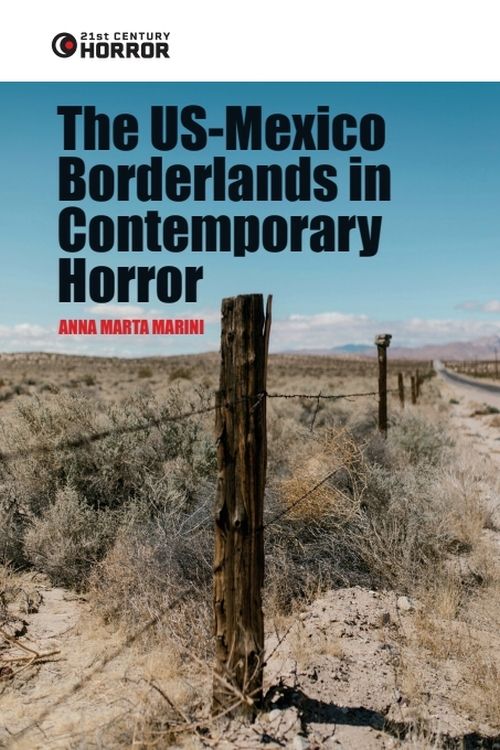
Examines US-Mexico borderland representations in horror films, TV series and comics
Tell us a bit about your book.
The book provides an overview of the horror set in the US-Mexico borderlands, where the monstrous is connected to the encounter with Otherness and where terror lies at the interface between the familiar and the unfamiliar. It looks at US popular culture fictional narratives that represent the US-Mexico borderlands from a mainstream standpoint. The selected films, graphic narratives and TV series embrace this nature and make it a fundamental pivot of their unfolding narratives. The US-Mexico borderlands become a locus of danger and horror because of their inherent liminal instability, porosity and hybridity in which questions of identity related to ethno-racial conflict, neo-/colonial legacies and US imperialism play a role. Through this lens, the selected texts thus aim to highlight how the US-Mexico borderlands have been depicted in horror media in the twenty-first century so far.
What inspired you to research this area?
My PhD dissertation (currently under contract with the provisional title Gone South: The American Experience of Mexico in US Cinema) examined the representations of Mexico in US American cinema through the lens of an original model of analysis. While working on the corpus, many filmic horror examples emerged, and I noticed that they were often connected to this idea of the borderlands as a particularly dangerous place. That is where the research for this monograph stemmed from, integrating as well the work I have been doing on borderland horror comics in recent years. It is as well the very first monograph published on the topic!
What was the most exciting thing about this project for you?
I think what I find most rewarding about the publication of the book as a result of this project is the possibility to share with colleagues and people interested in the area a fresh examination of the corpus, within a framework that helps teasing out the peculiarities of borderland horror. Borderland representations in general have become increasingly present in mainstream US American texts, as issues and discourses related to border enforcement and undocumented migration have shaped US American popular culture in a broad sense.
Did you discover anything particularly strange or surprising?
What perhaps surprised me at times is how audiences often seem to acknowledge that the topics presented by borderland horror are relevant, but at the same time cannot quite piece together the political weight that these representations come to embody. For example, while most viewers are familiar with the (ab)use of the so-called yellow filter whenever Mexico or the borderland region are visually depicted, the connection to the fact that the filter conveys a sense of backwardness and impurity is rarely drawn.
Did you get exclusive access to any new or hard-to-find sources?
Working on mainstream texts I did not really need to get exclusive access to resources useful to build the corpus. However, I had to sieve through a vast reservoir of representations that at times either are complicated to retrieve or have fallen into media oblivion shortly after their release – in part due as well to the distribution patterns of the horror industry.
Did your research take you to any unexpected places or unusual situations?
For example presenting on this research at conferences, it has been interesting to see how colleagues who are not interested in or familiar with horror texts find their analysis engaging due to the timeliness and relevance of the topics at hand. Academics who work on fiction related to undocumented migration not so often consider the genre and its implications; at the same time, they might have ‘outsider’ observations that enrich my own view of borderland horror.
Has your research in this area changed the way you see the world today?
I find that border-related topics have become more pertinent than ever with the onset of the current US administration, and their transposition to popular culture texts is key to the shaping of public opinion. While I have been working on US-Mexico borderland representations for quite some time, there is always some new and more current aspect to look into.
What’s next for you?
My current project revolves around anti-immigration discourses within ethnoracialised communities and how these stances seep through popular culture texts. It is to some extent an expansion on this book’s line of research and approach, trying to examine how the perception of border-related issues is influenced by popular media and, at the same time, it influences the type of representations that are produced.
About the author
Anna Marta Marini is currently a Humboldt Research Fellow at the John-F.-Kennedy-Institut für Nordamerikastudien (Freie Universität Berlin). Her work mainly lies at the intersection of political discourse and popular culture with a focus on visual media and critical discourse analysis, as well as horror and gothic mediascapes, on which she has presented and published extensively. She is the editor of several essay collections, including The Gothic and Twenty-First-Century American Popular Culture (Brill, 2024) and Latinx Representation in Contemporary Popular Culture and New Media (Brill, 2024), as well as the author of the monographs The US-Mexico Borderlands in Contemporary Horror (EUP, 2026) and Gone South: The American Experience of Mexico in US Cinema (SDSU Press, expected 2026).