

by Angus Sutherland
In 1831, an aging sheep farmer in the remote uplands north of the Anglo-Scottish Border was prompted to reflect upon ‘the changes in the habits, amusements, and condition of the Scottish peasantry’ since his childhood in the 1770s. His immediate answer, written for the new Quarterly Journal for Agriculture, is unequivocal. They are ‘better fed, better clothed, and better educated than the old shepherds and hinds.’ And yet the picture soon grows more complicated and even contradictory, for the author of the article in question was no ordinary farmer, but James Hogg (1770-1835), now best known for his 1824 novel The Private Memoirs and Confessions of a Justified Sinner.
Above all, Hogg laments the ‘great falling off’ in a once thriving culture of communal song. At the time of writing, ‘song-singing is at an end’. Much of the blame is laid at the feet of Walter Scott, whose Minstrelsy of the Scottish Border inflicted a ‘deadening blow … on our rural literature and principal enjoyment by the very means adopted for their preservation.’ Songs should be the product of the common voice and ear, not the private pen.
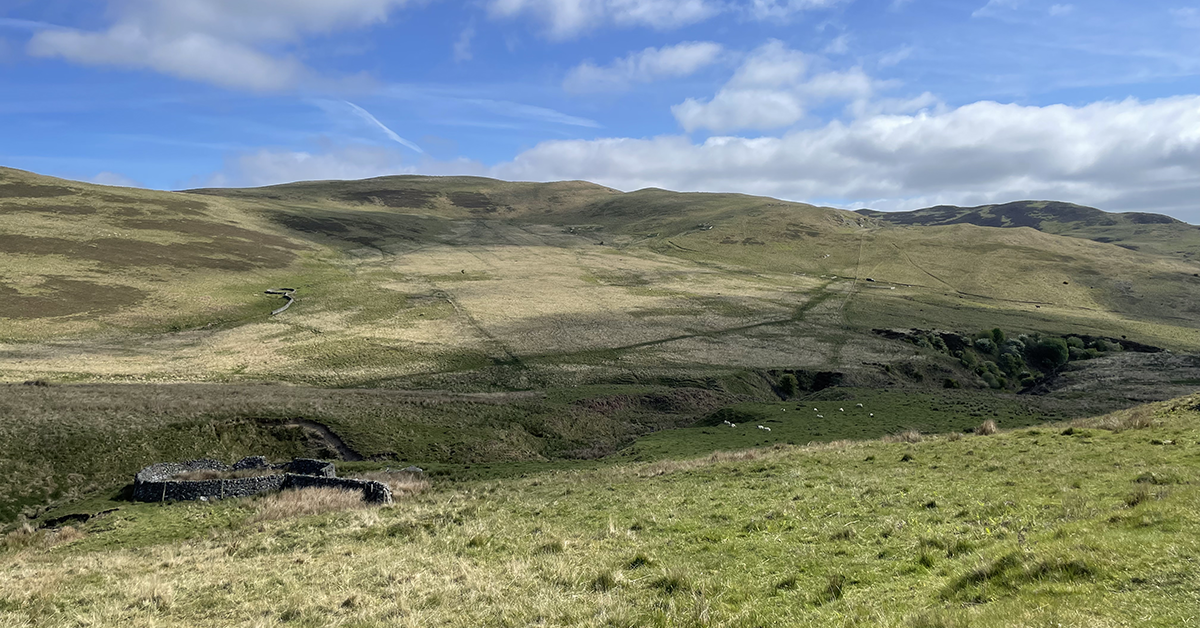
But the shepherds and farm servants of the 1830s had more profound causes to be ‘less cheerful and happy’, causes which were remote from their everyday lives, but which struck profoundly at the very ground beneath their feet. Although Hogg’s native Ettrick Forest appeared to contemporary observers, and even Hogg himself, as a wild and archaic region, it was, even before the Reformation, a laboratory for experiments in extensive sheep-farming. When the abbeys were dissolved, their lands and livestock reverted to the local aristocracy. The more astute of this latter group could dramatically expand their domains and flocks, particularly after Scotland’s 1603 regal union with England. Most successful of all were the Scotts of Buccleuch, who, in Hogg’s wry account, had eventually ‘gotten haud o’ a’ the South of Scotland’.
Hogg wrote his remarks on the changed Scottish peasantry from Altrive, the small farm granted him, for life and for a pittance, by the fourth Duke of Buccleuch. The fifth Duke would later evict him from a much bigger farm that he’d rashly taken on hoping for a more substantial income to support his growing family. Hogg was also writing amidst the furore of debate about Reform and the extension of the franchise. Hogg’s literary associates and patrons in Edinburgh were opposed even to these strictly curtailed democratic concessions, and he tended to follow that Tory line. It is in this light that we should read his hearkening after a time when the social order was ‘uniform, cheerful and right’ (which he dates c. 1688 to 1789).
Hogg reserves special contempt for the farmers, who have set themselves up as ‘fine gentlemen’ on the back of ‘ruinous war prices’, and the gamekeepers, ‘the most vexatious, insolent, and insignificant persons in the whole world.’ Conspicuously absent are the local magnates, such as the Buccleuchs, to whom the bulk of the profits were flowing. Hogg did have some pointed words for this class, but, judiciously, he reserved these for the pages of the Farmer’s Magazine, whose Whig politics were more hospitable to such criticism. In a piece signed ‘the Ettrick Shepherd’ and published in 1817, as a post-war agricultural depression raged, Hogg wrote that ‘it is high time’ that the landowners were made aware of ‘the critical circumstances of their farmers’. If they didn’t pay heed, he added somewhat menacingly, ‘they must infallibly come to the knowledge of them in a way that is neither creditable nor profitable’.
All of this stands in marked contrast to the optimism of The Shepherd’s Guide (1807), Hogg’s most substantial work on farming. He wrote this piece amidst those ruinous war prices, ‘humbly hoping that the perusal will contribute to the cause of humanity, as well as to individual advantage, and national benefit.’ To these ends, Hogg proceeds to transcribe his observations of the causes and remedies of various diseases afflicting sheep. He adds miscellaneous practical tips which, we can readily gather, are based on his own practice in the field. In one particularly vivid case, he suggests that Sturdy, a parasitic disease causing cysts to form in the brain, is best treated by the insertion of a knitting needle via the sheep’s nostrils.
For all his ingenuity, Hogg never quite found a satisfactory remedy for the social ruptures opened up by the shift to capitalist sheep-farming, which he felt had turned the ordinary peasant into a ‘slave’, hence his lapsing into nostalgia for an imagined golden century between the British and French revolutions. What he didn’t lack was confidence in himself and his fellow shepherds. These, he wrote in 1831, ‘form a very intelligent and superior class of the community.’

About the author

Angus Sutherland is a postdoctoral researcher and tutor working at Edinburgh Napier University. He has written about W. G. Sebald, James Hogg, emblems, theology and sheep farming. He and Alex Deans are co-editing Hogg’s The Shepherd’s Guide, which is forthcoming with EUP. It will include all of the articles cited above.