



by Michael Ray Taylor
Examines Robert Ferguson’s 1699 Vindication, which developed a liberal Jacobite defense of Native American sovereignty and property rights.
Historians are confronting a pivotal phase in the evolution of their discipline due to the rise of conservative populism across Europe and the Americas. In its worst form, this produces false revisions of the historical record. However, the more intellectually serious elements of this political movement simply contest the dominance of progressive values in the discipline and the overextension of leftist arguments past what they view as common sense and sound historical practice.
Reexamining Colonial Studies
In colonial studies, this development has taken the form of renewed scrutiny of the motives of colonists and their interactions with indigenous peoples. Rather than rejecting this trend as reactionary revisionism, historians should view it as an opportunity to prune decolonial theory: the system of ideas dedicated to the principle that colonisation was inherently immoral, and which then attempts to reverse all effects of colonisation on modern societies. Such refinement would rid the theory of its excesses and more honestly deal with historical actors and the ramifications of their actions. It is undeniable that colonisation frequently produced catastrophic outcomes throughout history, and that many colonial powers pursued exploitative and abusive policies. It is also true that this describes the vast majority of colonial experiments. However, it is an exaggeration to claim, as modern decolonial studies do, that the act of colonisation is inherently one of domination and subjugation. This claim reflects a late twentieth-century moral paradigm currently undergoing reevaluation. This progressive morality tends to oversimplify every human interaction into a binary between oppressor and oppressed, analysed strictly through the lens of power. In practice, human activity is rarely so straightforward. Its multifaceted nature is nowhere more obvious than in the intricate realities of the colonial world. Alternative moral frameworks, even those from conservative populist worldviews, therefore, warrant serious scholarly engagement rather than outright dismissal.
A Jacobite Conception of Ethical Colonisation
“‘Ancient Natives’: A Competitive Jacobite Defence of Indigenous Society and Ethical Colonisation” contributes to this reconsideration by tracing a particular Jacobite conception of empire in the Americas, which rejected what it conceived of as the immoral practices of other colonial ventures. The article first analyses the theoretical arguments of Robert Ferguson, a Scottish Presbyterian Minister and Radical Whig who converted to Jacobitism and Anglicanism. Ferguson called for a Stuart restoration along classically liberal, Lockean lines. In 1699, he published A Just and Modest Vindication of the Scots Design, for the Having Established a Colony at Darien. This book has been overlooked by modern scholarship. Yet within, he sought to substantiate the Scottish colonial title to Darien by constructing a theological framework of native rights. Ferguson drew on the principles of contract theory, Salus Populi, limited government, consent of the governed, and natural property rights and applied this to the indigenous peoples of America. He went so far as to approve native rebellion against unjust colonial powers.
Jacobite Practice of Ethical Colonisation
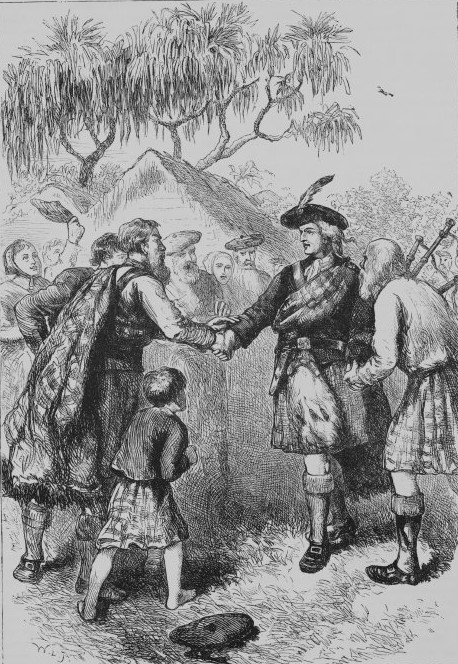
The article then traces the impact of Ferguson’s theories on the actions of Jacobites in the American colonies. Sir William Keith, governor of Pennsylvania and a former Jacobite, used the Vindication as he crafted his Native American policy. Keith’s ideals were encapsulated in his 1730 Cherokee Treaty, which influenced the 1732 Carolina-Creek treaty and the Yamacraw/Creek treaties of James Oglethorpe, another Jacobite, from 1733 to 1743. In this way, the article contends that Ferguson’s Whiggish Jacobite principles underpinned a Jacobite approach to Native American relations in the colonies for more than a decade. In addition to informing Jacobite historiography by further developing an intellectual history of the movement, “Ancient Natives” offers proof that some colonial theorists publicly repudiated exploitative colonial practices. They instead sought to articulate a model of colonisation that benefited indigenous peoples, not through self-centred absolutist paternalism, but through a form of liberal egalitarianism. The arguments contained in this article should attract those interested in intellectual history, political theology, Jacobitism, the Atlantic World, and broader imperial studies.
About the author
Michael R. Taylor is a PhD candidate and Beattie Scholar in History at the University of Aberdeen, and Instructor of History at Louisiana State University at Eunice.