Skip to content
  • Cultural Studies
    • French Studies
    • Gender Studies
    • Irish Studies
    • Film and TV
    • Theatre and Dance
    • Islamic and Middle Eastern Studies
  • History
    • British History
    • Classics and Ancient History
    • Cultural History
    • Natural History
    • Religious History
    • Scottish History
    • World History
  • Language and Literature
    • Modernism
    • Literary Theory
    • Pre 19th Century Literary Studies
    • Post 19th Century Literary Studies
    • Scottish Literature
    • Atlantic Literature
    • Linguistics
  • Law
    • Comparative Law
    • European Law
    • Islamic Law
    • Roman Law
    • Scots Law
  • Politics, Philosophy and Religion
    • Religion
    • Philosophy
    • Politics
    • Political Philosophy
    • Scottish Politics
    • Film Philosophy
  • Publishing

  • About Us
  • Journals
  • Books
  • SUBSCRIBE TO OUR BLOG
Edinburgh University Press Blog

No results
  • Cultural Studies
    • French Studies
    • Gender Studies
    • Irish Studies
    • Film and TV
    • Theatre and Dance
    • Islamic and Middle Eastern Studies
  • History
    • British History
    • Classics and Ancient History
    • Cultural History
    • Natural History
    • Religious History
    • Scottish History
    • World History
  • Language and Literature
    • Modernism
    • Literary Theory
    • Pre 19th Century Literary Studies
    • Post 19th Century Literary Studies
    • Scottish Literature
    • Atlantic Literature
    • Linguistics
  • Law
    • Comparative Law
    • European Law
    • Islamic Law
    • Roman Law
    • Scots Law
  • Politics, Philosophy and Religion
    • Religion
    • Philosophy
    • Politics
    • Political Philosophy
    • Scottish Politics
    • Film Philosophy
  • Publishing
  • Interview with Maggie Humm

    Maggie Humm reflects on feminist criticism, life-writing, and Virginia Woolf’s influence.

    April 17, 2026
    Read more: Interview with Maggie Humm

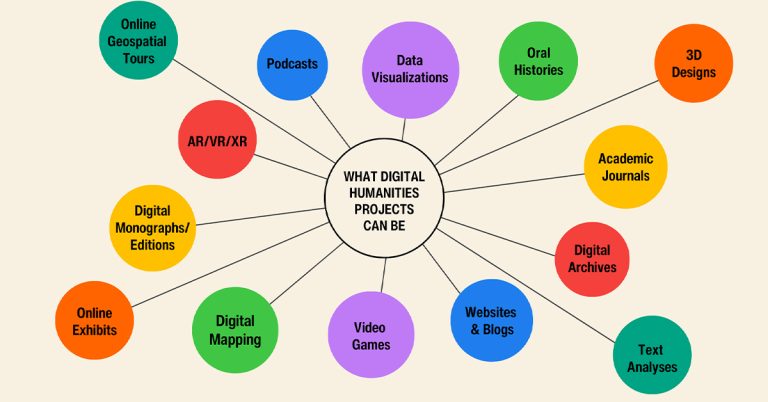
A network mind map with a central circle that reads “What Digital Humanities Projects Can Be” and lists the following possible digital humanities projects: Online Geospatial Tours, Podcasts, AR/VR/XR, Digital Monographs/Editions, Online Exhibits, Digital Mapping, Video Games, Websites & Blogs, Text Analyses, Digital Archives, Academic Journals, 3D Designs, Oral Histories, Data Visualizations.

5 Reasons Why All Graduate Education Should Include the Digital Humanities

by Bailey Betik and Alexander Cors Graduate education has traditionally been the final stage of academic apprenticeship, where individuals delve deep into their chosen fields of study. It’s a time for specialization and expertise, where students engage in critical thinking…

  • Edinburgh University Press
  • October 20, 2023

Mediated intimacy: Lessons for the future from lockdown creativity

by Emily Goodwin and Sarah Brophy Video calls. Collaborative docs. Memes. “Live” concerts. Vaccine selfies. Netflix. Case rate data. Digital media provided lifelines during the COVID-19 global public health crisis. Yet as everyday life became more screen-centric than ever, the…

  • Edinburgh University Press
  • August 11, 2023

Popular Posts

Interview with Maggie Humm

Stone gargoyle perched on Notre-Dame Cathedral overlooking the dense rooftops of Paris, with the Seine River running alongside the city and the Eiffel Tower visible in the distance beneath a dramatic, cloud-filled sky.

Q&A on French Horror

A dimly lit movie theater filled with seated audience members facing a large, brightly glowing screen. Rows of red upholstered seats extend toward the front, and the ceiling features curved architectural details with recessed panels. The atmosphere suggests a film screening in progress.

Five of the most unusual Sunday Opening conditions

Standing on the Shoulders of Giants: From William Still’s Underground Railroad Records to Digital Analysis

Beyond ‘girlboss feminism’: queering Irish women’s writing

Subscribe To Blog Via Email

Enter your email address to subscribe to this blog and receive notifications of new posts by email.

Copyright © 2026 - Edinburgh University Press | All Right Reserved. | Privacy Policy