

By Patrick Valiquet
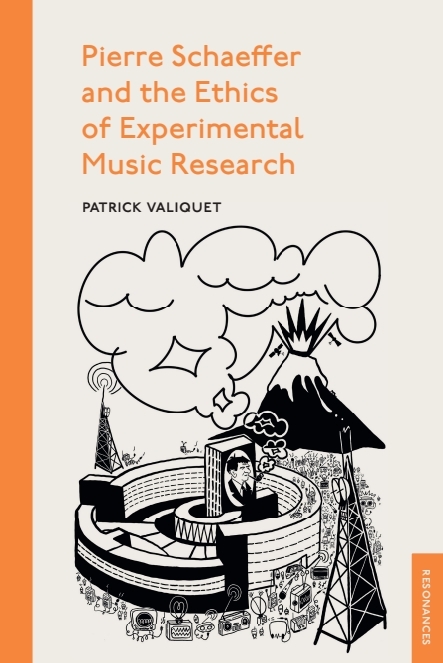
The first monograph in English to offer a comprehensive account of Pierre Schaeffer’s music philosophy.
What should musicians do with a medium that reduces their work to acoustic waves, making transmission and reception possible even in the absence of playing? What aesthetic, social and technological transformations are required to move from a time when musical commodities were consumed in reading and playing as a preparation for hearing into one when they are consumed in the hearing alone?
These were among the most central questions motivating a series of experiments in music, radio and television research by novelist, dramatist, broadcaster and educator Pierre Schaeffer in his work for France’s national broadcasting services between 1938 and 1980. These questions also informed Schaeffer’s roles as advisor and teacher on the transformation of music by contemporary media for the Conservatoire de Paris, the French information and overseas ministries, and the broadcasting policy committees of UNESCO and the Council of Europe.
The most famous of Schaeffer’s experiments, a genre of tape-based composition known as musique concrète, also earned him an uncomfortable reputation as a musician. He found the reputation uncomfortable because, to his mind, his experiment had failed to produce useful results. What he had set out to define was a solfège, a compact, memorable system of sound-symbol relations that any musician could use to understand the kinds of sounds that would be desirable in the radio or recording studio, a way of organising noises so that they could be used just like notes. The purpose of music had not changed: this music of listening alone should move the soul just like music already does. But there were problems. Relations between ears and noises seemed to be far more complex than relations between notes on a page or keys on a keyboard.
Being a writer first and foremost, Schaeffer wrote several books about his failure. To his dismay, these then became the basis for a new school of composers who enacted the book’s tentative steps toward a solfège as its dogma. He came to view the situation ironically and went on to write esoteric novels deriding the foolishness of the aspiring ‘avant-gardists’ who had mistaken his youthful blunders for the latest innovations in ‘music theory’.
‘Godfather of Sampling’?
My book warns contemporary sound studies scholars not to make the same mistake as Schaeffer’s followers when they refer only to his music research in support of strong claims about his historiographical or philosophical significance. Schaeffer-as-great-composer narratives support many mythical movements in contemporary historiography: that of the avant-garde across the threshold between Western music’s ‘print’ and ‘oral’ cultures, that from visuality to aurality within sound studies itself, among others. After his death in the mid-1990s, it was common to see him celebrated in sound studies literature as the ‘inventor of turntablism’ or ‘godfather of sampling’, serving gendered and classed assumptions about the progress of music technology that ultimately only serve as marketing gimmicks, as Timothy Taylor argued over 25 years ago.
And yet, it was still Schaeffer the ‘experimental composer’ whose work was declared retrospectively to be ‘shared ground’ at the moment of sound studies’ consecration as a serious academic discipline in the mid-2000s. Critics today accept the same terms. For Georgina Born, Schaeffer’s ‘compositional philosophy’ devolves too easily into ‘formalist’ abstraction. For Brian Kane, his empirical insights are overshadowed by a rigid ontology insufficiently attuned to cultural, historical and technological contingencies. As correct as these critics may be on their own terms, they still assume Schaeffer to have been a composer selling a compositional system. To what degree does this represent an avoidance to contend with the goals that he actually pursued in his experiments?
Listening as ‘Spiritual Sports’
Schaeffer never really limited his theoretical project to the idealised relation between listener and ‘sound object’ that has so worried his critics. Every phase of his research subjected the technical mediation of listening and sound to intense moral and political scrutiny. Realising that he was only a beginner, his main goal was not to innovate ‘musical works’ or ‘work-concepts’, but to experiment with the verb form of work, work as in labour. The acousmatic situation establishes an active, inquisitive, creative relation between listener and sound. Listening to music became work informed by the incomplete, provisional, decommodified senses of devotional ‘exercise’ or playful ‘sport’, drawing upon the spiritually-loaded movement-meditation system of Armenian mystic Georges Gurdjieff (a close descendent of Rudolf Steiner’s eurythmy and Émile Jaques-Dalcroze’s eurythmics). Only through this intensive, inward exploration, thought Schaeffer, could listeners hope to prepare themselves for the dawning crises of media decolonisation and globalisation in an era of accelerating economic expansion.
Throughout his writing Schaeffer recalls to readers the profound moral duty instilled by his musician parents whenever they admonished him to practice his cello. The metaphorical ‘blinding’ of the ‘acousmatic situation’ instantiated by contemporary media forces musicians to practice their ears in a similar way. Informed by the recent work of Paul Rekret and Marie Thompson, I argue that my emphasis on the way Schaeffer moralised musical work reveals the essential role that questions of labour, bodies, cultures and politics must play to any history or sociology of ‘rational’ sonic technique.
By digging deeper into Schaeffer’s published and archived work, we can now map the reasons for his disciplinarian musical imagination to the neoconservative, neocolonial government apparatuses and late imperial moral sentiments that informed his literary imagination.
About the author
Patrick Valiquet holds degrees in music and digital media from McGill University, Concordia University, the Institute of Sonology and the University of Oxford and has taught music researchers at Notam, Bidston Observatory, and the Universities of Oxford, Edinburgh and Huddersfield. His own research on the history and philosophy of experimental music in the francophone world has been supported by the Social Sciences and Humanities Research Council of Canada, the Fonds de Recherche du Québec and the British Academy.

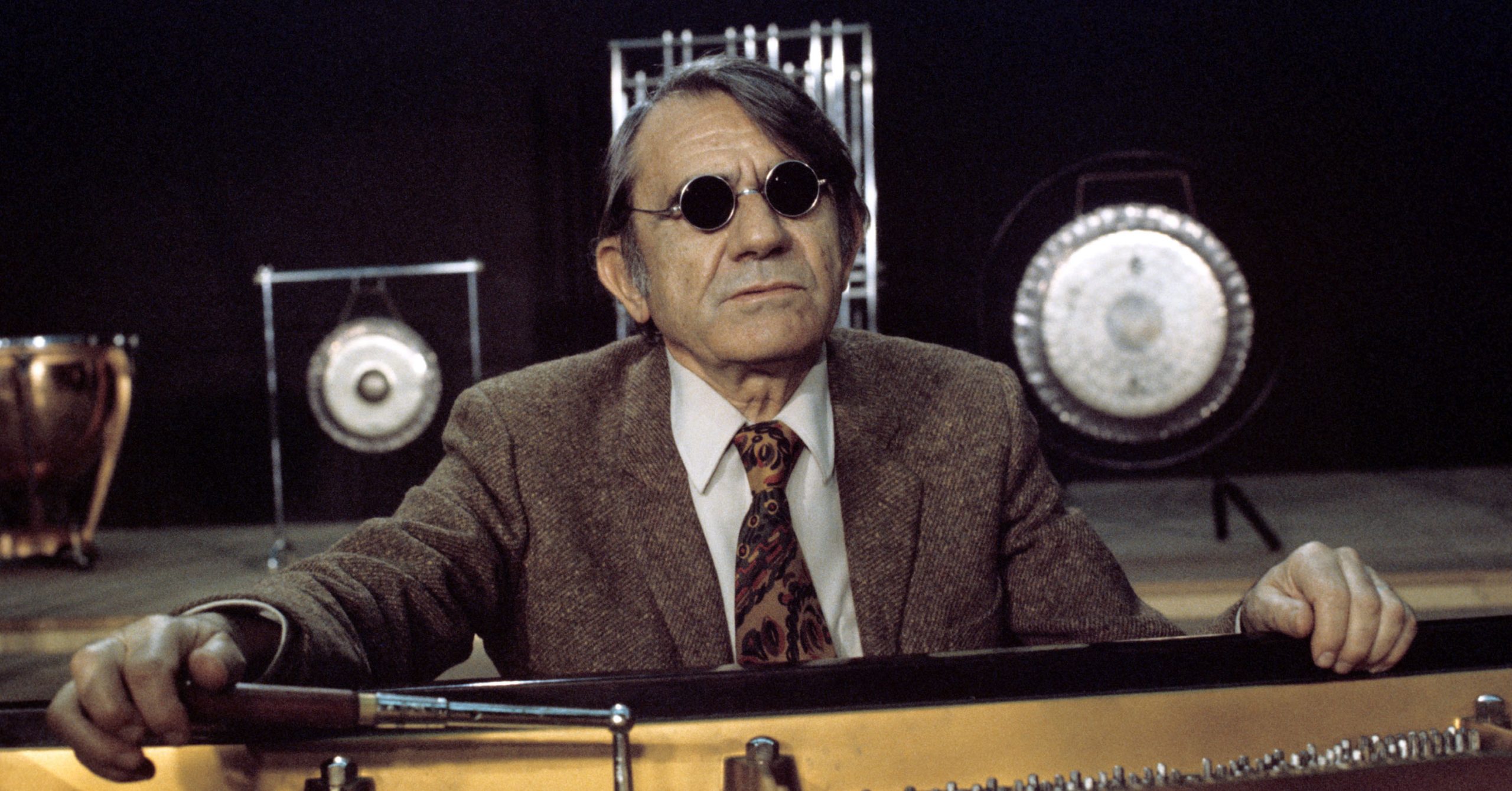
Featured image caption: ‘Pierre Schaeffer pretending to be blind for the 1979 television documentary “The Music Lesson”. (Photo by Laszlo Ruszka / INA via Getty Images)’