

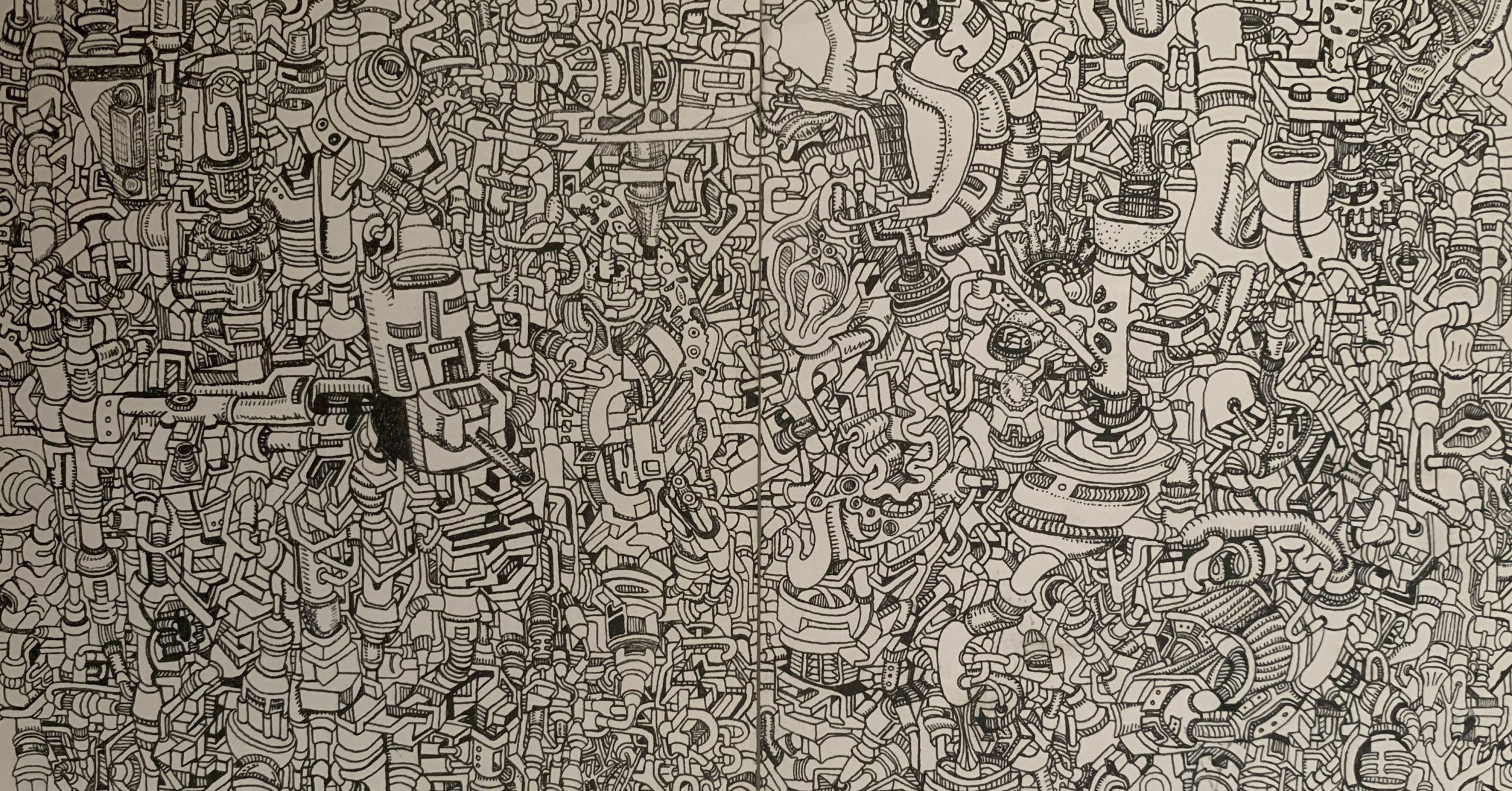

By Georgia Gibbs

Welcome to the first post in our ‘A Thousand Tiny Sexual Politics’ series, where scholars delve into the intersection of Deleuzian philosophy and feminist and queer theory to explore all things gender, sex and sexuality.
Georgia Gibbs kick starts the series by exploring whether schizoanalytic de-subjectification can enhance feminist interpretations of sexual normativity.
In 2000, Rosi Braidotti noted that an emerging “alliance between feminism and Deleuze is being negotiated in the new anti-Lacanian and ‘anti-maternalist’ colder political sensibilities in the 1990s” (Braidotti, 172). Since the 90s, self-consciously alienating, depersonalising theoretical gestures have continued to be picked up by left-accelerationist feminists and what might be more broadly called ‘post-schizoanalytic’ feminisms. Prominent theorists in this minor tradition of contemporary feminist theory include Sadie Plant, Mark Fisher’s work on the ‘femachine’, VNS Matrix, Laboria Cuboniks, and Cute/Acc.
Consistently, schizoanalysis is employed (within these discourses and more broadly) as a way of imagining an escape from the sexual status quo and into the future. Rarely, if ever, is Deleuze and Guattari’s thought employed to understand the process of becoming and remaining stuck in normative sexual relations. Schizoanalytic de-subjectification has, by and large, not been used to critically analyse the production and maintenance of hegemonic femininity, the stubborn stability of dominant and dominating images of womanhood. Can schizoanalysis be fruitfully employed to explain the stickiness of hegemonic gender roles, the way desires cling to regressive social arrangements?
A shared thought snakes its way across the body of ‘post-schizoanalytic’ feminist theory: that the process of producing ‘woman’ as a socio-historical entity – the simulation of ‘the’ feminine subject through a passive, unconscious stringing together of performative gestures – is driven by a machinic, impersonal sexuality that precedes anything recognisable as subjectivity. Feminism is thus recast from a march towards the type of collective psychic transformation in which woman would be recognisable as a human subject to a matter of making a deal with the abstract, inhuman force by which ‘woman’ is continually produced and transformed. The desire that drives feminine performance thus does not belong to the psyche but is dispersed across the situation of femininity itself as a process of auto-production.
In these discourses, femininity is a runaway destructive-creative process of mutating itself that continually leaks out of the hegemonic category of ‘woman’. Some speak of wresting the process from the hands of men, ‘hijacking’ it; or else declare the process is already inevitably escaping human control and that the best course of action is hitching a ride out of humanity. The dissolution of ‘the feminine subject’ into femininity as runaway socio-technical process is positioned as a way out of the humanism in which woman is subject to man; a threshold onto something new.
In popular modern and contemporary feminist theory, the desire to conform with hegemonic femininity is generally positioned as having its genesis within the psyche. Problematic or disempowering desires are thus psychologised and enclosed within subjectivity. Deleuze and Guattari turn the process inside out; desire precedes subjectivity. A schizoanalytic eye on hegemonic sexual relations would suggest that desire is the force that arranges these relations in their own particular way. Not a desire that belongs to ‘you’ or ‘me’ but desire as a pre-personal process of synthesizing a phenomenological reality in which ‘you’ and ‘I’ exist. Impersonal, machinic sexuality is the non-subjective ‘doer’ behind the deeds that sediment into a stable, shared aesthetic structure of sex/gender.
Injecting a careful dose of de-subjectification into feminist discourses on normative sexuality may enable an escape from persistently asking how desire sticks to the most regressive forms of sexual relation despite subjects ‘knowing better’ (Angel; Bauer; Garcia; Kogl; Long Chu; Saketopoulou; Srinivasan; Ward). It helps us exit the framework of pinning it on the subject: abandoning accusations that she acts out of her false consciousness, her unconscious paternal fixation, her unhealthy self-esteem, her cynical awareness of her situation. Like psychoanalysis, schizoanalysis insists that she acts out of her desire. Unlike psychoanalysis, this schizoanalytic desire is in no way ‘hers’, is not a product of her subjectification. It did not come from her; ‘she’ comes from enacting ‘it’.
The dominant sex/gender system is a style of relation. The desire that drives the reproduction of normative sexual relations is therefore, at some level, akin to a stylistic impulse; “A sort of art for art’s sake in the libido, a taste for a job well done” (Deleuze and Guattari, 347). As such, an irrational aesthetic impulse inheres in the process of (re)producing normative sexual relations that, schizoanalysis wagers, precedes the normatively sexed subject. Theoretically reducing the subject to the impersonal pulsion of a style of relations to express itself is not necessarily a liberating exercise. It can be merely descriptive, forming the basis for critique of these relations. It is a way of reframing the issue from one of self-help to negotiating with real forces outside one’s ‘self’. But just because these forces are non-anthropomorphic in no way makes them liberatory, unproblematic, or inevitable. Thus, it is necessary to develop the ‘negative task’ of schizoanalysis – that of critique.

About the author
Georgia Gibbs is a media studies PhD student at Monash University whose research focuses on the intersection of feminist theory, schizoanalysis, and contemporary digital cultures. She also has a visual art practice and produces works related to her research. Her current research project analyses the phenomenon of social media contagion through the lens of feminist media studies, critical theory, and schizoanalysis. She has recently published research on the application of schizoanalytic theory to the analysis of feminine sexuality in horror film and has presented research on femininity and negative affectivity in digital cultures. Her upcoming publications and presentations focus on schizoanalysis and contemporary feminist sexual politics, and the relation of Deleuze’s theorisation of masochism to psychoanalytic queer theory.
Instagram: @ggibbsonline
Citations
Braidotti, Rosi. “Teratologies.” Deleuze and Feminist Theory, edited by Ian Buchanan and Claire Colebrook, Edinburgh University Press, 2000, pp. 156–172, https://doi.org/10.1515/9781474400527-010.
Deleuze, Gilles, and Felix Guattari. Anti-Oedipus: Capitalism and Schizphrenia. Translated by Robert Hurley et al., University of Minnesota Press, 1983. Originally published by Les Editions de Minuit, 1972.
Image Credit: Georgia Gibbs, Machine 1#, 2024.