



By Thomas Telios
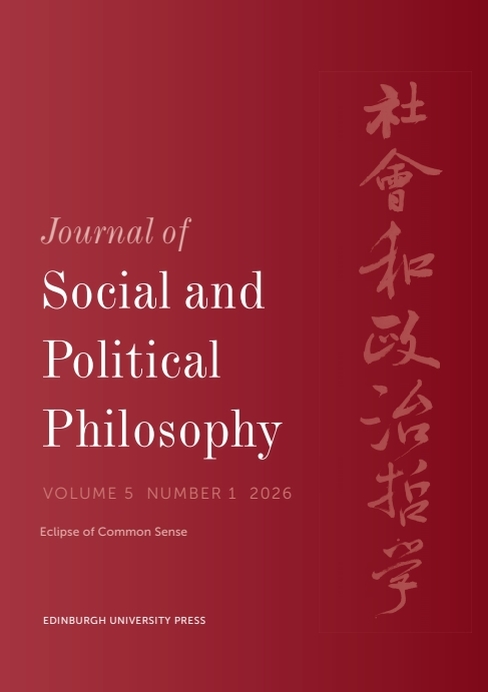
Thomas Telios is the Guest Editor of Journal of Social and Political Philosophy, 5.1: ‘Eclipse of Common Sense’
Few concepts feel as self-evident—and yet prove as elusive—as common sense. Invoked to justify political decisions, moral judgments, and everyday reasoning, common sense is often presented as something everyone simply ‘has’. But what exactly is common sense? Who belongs to it? And what kinds of political work does it perform?
This special issue takes up common sense as a foundational yet deeply ambivalent concept in modern political, philosophical, and social thought. Rather than treating common sense as a stable faculty or a universally shared body of knowledge, the contributions gathered here approach it as a historically contingent, politically charged, and performative concept—one that simultaneously enables democratic participation and threatens democratic pluralism.
The urgency of revisiting common sense today is undeniable. Across contemporary political landscapes, appeals to common sense have re-emerged as powerful rhetorical tools. They promise clarity in moments of crisis and simplicity in the face of complexity. Yet such appeals often function by drawing boundaries: between ordinary people and elites, reason and nonsense, insiders and outsiders. In this way, common sense can become a means of foreclosing debate rather than opening it, transforming disagreement into irrationality and pluralism into pathology.
At the same time, common sense has long served as a democratic resource. Historically, it has enabled those excluded from formal education, expertise, or political power to claim epistemic and moral authority on the basis of lived experience. From early modern political thought to grassroots movements in the present, common sense has provided a language through which ordinary people assert their capacity for judgment, participation, and self-rule. Democracy, after all, presupposes that citizens do not need esoteric knowledge to deliberate about the conditions of their shared life.
The essays in this special issue explore this tension in depth. Drawing both on European and Non-European traditions ranging from Cicero’s sensus communis to Neo-Confucianism, Enlightenment philosophy, critical theory, pragmatism, post-war French philosophy, political anthropology, and queer theory, the contributors examine how common sense has been conceptualized, mobilized, and contested across time and contexts. Rather than asking whether common sense is ‘good’ or ‘bad’, the issue asks how it works—epistemically, rhetorically, affectively, and politically.
Several contributions foreground the relationship between common sense and democracy. They argue that democratic life depends not only on institutions and laws but also on shared habits of mind: minimal agreements about truth, solidarity, and the legitimacy of disagreement. When these background assumptions erode, democracy falters—not only through legal or constitutional breakdown, but at the level of everyday judgment and mutual recognition. Common sense thus appears as a fragile but necessary condition of democratic coexistence.
Other essays examine the exclusions built into common sense. Because common sense is defined as what is widely shared rather than universally held, it always implies a remainder: those who supposedly lack it. This dynamic helps explain why common sense so often aligns with anti-pluralist and populist politics. By presenting certain views as self-evident, appeals to common sense can delegitimize dissent and erase the social, cultural, and historical specificity of judgment. The issue explores how such exclusions operate along lines of class, gender, race, expertise, and nationality.
Language and translation also play a crucial role. The special issue highlights how “common sense” carries different meanings across linguistic traditions—ranging from everyday practicality to communal ethos and shared moral feeling. These semantic variations reveal that common sense is never simply given; it is shaped by cultural histories and political imaginaries. Attending to these differences allows for a more precise understanding of how common sense is invoked in specific contexts—and to what ends.
Importantly, the issue does not treat common sense as merely reactive or backward-looking. Several contributions emphasize its aspirational dimension: the capacity of common sense to be reshaped, expanded, and rearticulated. When common sense becomes more inclusive—when it absorbs previously excluded experiences and perspectives—it can function as a vehicle for democratic transformation. Grassroots movements, in particular, often succeed by translating complex forms of knowledge into idioms grounded in everyday life, forging new commonsensical horizons without rejecting expertise outright.
Taken together, the essays argue that common sense is neither a neutral foundation nor a simple ideological illusion. It is a dynamic site of struggle: between expertise and experience, unity and plurality, tradition and transformation, restoration and utopia, past and future. Understanding common sense as a performative and contested concept allows us to see how it both reflects and reshapes the political worlds we inhabit.
At a moment when appeals to common sense are everywhere—and when democracy itself appears increasingly fragile—this special issue offers critical tools for thinking with, against, and beyond the obvious. It invites readers to question what is taken for granted, to examine who gets included in the name of the ‘common’, and to imagine how shared judgment might yet serve more inclusive and democratic futures.