



by Engin Isin
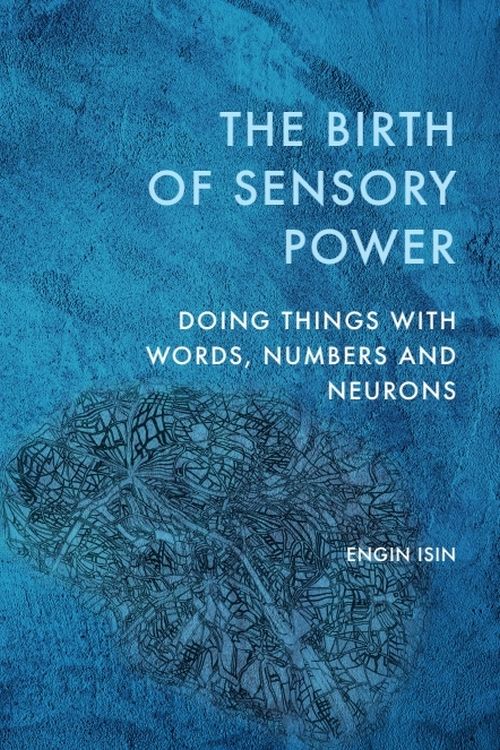
This book examines the transformation of historical forms of power and the emergence of new polities and citizen-subjects produced by a new form of power – sensory power – in the 21st century.
In 2020, Evelyn Ruppert, a data sociologist, and I, a political theorist, published an article exploring how pandemic practices unveiled a new form of power. Our focus was primarily on the data practices that the pandemic had popularised. All sorts of media buzzed with concepts like clusters, hotspots, visualisation and dashboards, many stemming from statistics, epidemiology and computing. This confluence of life analytics and data analytics introduced a strange yet familiar language into public consciousness, distilling complex concepts into practical advice for combating the coronavirus.
While this article touched on a broader power question, I hadn’t realised theorising power had become somewhat stalled in dominant political theory compared to other concepts. Following the article’s publication, I became increasingly interested in this project of rethinking the concept of power in relation to an emerging form, sensory power. Consequently, I became convinced that using power as a concept to understand this confluence between life analytics and data analytics would require revisiting the concept of power from Spinoza and Nietzsche through Deleuze, Foucault and Bourdieu with Austin and Derrida. Although these scholars are not necessarily all associated with theorising power, each had shaped my research and writing for nearly forty years on forms of power, knowledge, class and capital.
What I hadn’t also realised is that the convergence of life analytics and data analytics had taken another path than modern historians of statistics largely unnoticed: cybernetic machines. Throughout the research I became fascinated by the convergence between datasciences and neurosciences and I was deeply drawn to the brain-machine analogy. This analogy, which became known as the imitation game, undergirds sensory power, which is the very backbone of what is now known as artificial intelligence.
Although much has been written about neurosciences and the brain-machine analogy, my concern with rethinking the concept of power was hugely helped by critical studies on smart cities – artificial intelligence driven urban systems for governing peoples and things. These projects either resulted in literally thousands of partial projects integrating systems within cities or involved creating systems of cities for imagining networked states. Writing a history of this development became my primary objective.
The most exciting thing about doing this research was to discover that the brain-machine analogy was not an analogy at all. The convergence between datasciences and neurosciences rendered the brain-machine analogy into an equivalence: ‘The imitation game signals the convergence of datasciences and neurosciences, complicating the question of whether the brain is modelled after the machine or whether the machine is modelled after the brain. Or is it the conjunction of both? (p. 174).
If there were converging developments in datasciences and neurosciences, it was necessary to weave their connected threads. It first required tracing datasciences to the seventeenth and eighteenth centuries with historians of statistics. It was then necessary to give an account how discoveries in mathematics led to the emergence of computing machines in the late nineteenth century. It was possible only then illustrate how in the 1930s brains and machines were imagined as analogous things. This was a prehistory of artificial intelligence, cybernetics, and autopoiesis.
As a student of architecture and urban planning at the Middle East Technical University in the 1980s, I had become a specialist in the emerging field of computer graphics and then a critical quantitative geographer at the University of Waterloo, specialising in multivariate and spatial statistics. I studied cybernetics, systems theory, and remote sensing. And at University of Toronto, as a hybrid geography-philosophy student, The Mind Over Machine (1986) by Hubert and Stuart Dreyfus was already a prominent book in my library. Nearly forty years later while researching for this book about how scientists, engineers and neurologists collaborated on the brain-machine analogy through massive military funding from the 1930s to the 1960s, the emergence of systems theory and cybernetics was a familiar area to me.
What was unfamiliar was how the brain-machine analogy had transcended building minds, as critics of artificial intelligence had feared and continue to fear. Instead, it was leading towards creating autopoietic machines. While autopoiesis and cybernetics are related developments, the former gained prominence later but subtly redefined cybernetics. Simply put, emerging in biology and spreading to human sciences, autopoiesis describes self-organising and self-controlling entities that are neither autonomic (robotic) nor autonomous (agentic). This logic has since permeated science, technology, and systems engineering and, I argue, has become a key principle in the creation of autopoietic machines in the twenty-first century.
How are sensory power and autopoietic machines related? The games we play, such as kingship (emerging 6,000 years ago), citizenship (2500 years ago), population (250 years ago) and imitation (100 years ago), alongside their corresponding forms of power – sovereign, disciplinary, regulative and sensory – became the organising narrative of my argument. The most challenging aspect of writing the book was weaving together these diverse games and forms of power to illustrate their interconnected development. Each new game redefined and was transformed by its predecessors ultimately embodying the complexity of the present.
This book invites us to rethink the concept of power by shifting our focus on datasciences and neurosciences and their convergence in designing, producing and using autopoietic machines. With more skills, time, space and energy, I’d have gone deeper into the genealogy of autopoiesis and cybernetics for creating polities as autopoietic machines. This book might generate further research in this area.
About the author
Engin Isin, Professor Emeritus of International Politics at Queen Mary University of London, has been driven by a central tension in his writing. This tension lies between imperial, colonial or national designs for making up people and how individuals subvert these designs through performative acts and the creation of political subjectivities. Isin explores this dynamic in his analysis of how people establish themselves as subjects in and across various polities – cities, nations, states, empires and now machines – and engage in and experiment with politics – power, knowledge and subjectivity.



Richly interesting and I look forward to taking a closer look at your book. My only comment would be to note the strange tendency to reductionist thinking regarding the brain-machine analogy, an examined and well-trodden territory for the interest of natural philosophy for a very long time, and with an ever-expanding array of data which actually fully contradicts this apparent ‘non-analogy.’ Autonomy, intentionality, agency, the causa sui may present us with problems even today in the biological sphere where their direct access to these questions is already problematized let alone the more ‘hard sciences’ of data, physics, or what have you.
If the mind is irreducible to the brain, the brain to the machine, and so on, we may find ourselves in a series of absurd acceptances of limitations — or perhaps we have not spoken sufficiently generally regarding either or any phenomena, which is what I would personally suspect. Then again conceptualizing the brain as a machine may be only reductionist, maybe entirely intentionally (there are of course elements of the world which should be considered in such contexts), but then again the other way about may be instead fully expansionary: if the machine is considered to be simply a ‘simple’ brain, or the brain a fuller and richer appropriation of what a mechanism as mediated by an intentional system can only ever hope to approximate, then maybe we are onto something.
It is hard to see past the danger that a hard physicalism in its current iterations will quickly become a thing of the past along the lines of these and other conceptual difficulties and that autopoietic ‘machinery’ might already be sneaking in something of these broad failures.