


by Andreas Weilinghoff
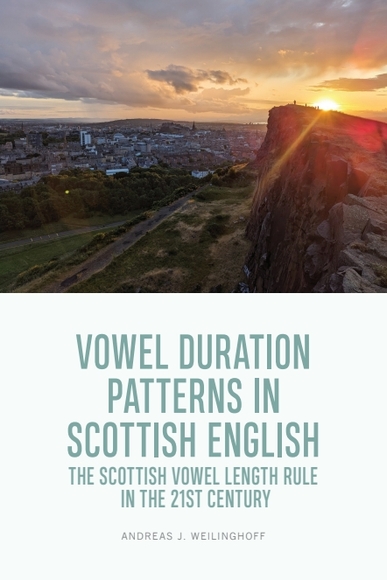
Vowel Duration Patterns in Scottish English is first comprehensive analysis of the Scottish Vowel Length Rule and Voicing Effect on a countrywide scale.
To understand why the Scottish Vowel Length Rule (SVLR) matters, let’s start with a few examples. Take the word moon. While most English speakers from around the world pronounce it with a long high vowel /uː/ – /muːn/ – many Scottish English speakers use a noticeably shorter vowel, often with a different and more fronted quality: /ʉ/. A similar pattern appears in the word speed, whose vowel is realized as a long /iː/ in most English accents, but is usually shorter in Scottish English. Interestingly, in most English varieties, there is a clear durational contrast between words like bead and beat, with bead incorporating a longer vowel. This contrast, however, is said to be absent in Scottish English. Conversely, Scottish speakers often distinguish clearly between crude and crewed through vowel length – a distinction that may not exist in other accents. And if the vowels in the words tide and tied sound different to you in both quality and length, chances are you have a Scottish accent.
The SVLR, also known as Aitken’s Law after its formulator (Adam) Jack Aitken, is a phenomenon that you can read about in just about every textbook on Scottish English phonetics and phonology. Although it has been described, revised and studied over the course of centuries, previous research has often produced contradictory results. Some central questions remain open: Which vowels are actually affected by Aitken’s Law? In which regions of Scotland (as well as in Northern England and Ulster) does the SVLR operate? Beyond regional variation, how do factors such as the age and gender of a speaker influence Aitken’s Law? And finally, what is the relationship between Aitken’s Law and the Voicing Effect – the vowel quantity alternation pattern found in most other varieties of English and, indeed, many other languages?
This new book, the first monograph ever devoted to the topic, seeks to find answers to these questions. To this end, the analysis draws on recent advancements in spoken data preparation. In particular, improvements in Automatic Speech Recognition (ASR) and forced alignment now facilitate the systematic processing of large corpora of natural speech. These advancements made it possible to examine the SVLR in far greater detail than before and to investigate the phenomenon in naturally occurring language. This is particularly valuable given the fine-grained interplay of suprasegmental and segmental factors that shape the duration of vocalic intervals, especially in spontaneous speech. Furthermore, this approach makes it possible to investigate how phonetic structures that are well documented in controlled production experiments may shift, adapt, or even disappear when speakers use language in naturally occurring contexts.
Many thanks to Edinburgh University Press
Vowel Duration Patterns in Scottish English is my first textbook published with Edinburgh University Press. And where better to publish a book on Scottish English than with EUP? As a publisher with a long-standing commitment to Scottish linguistic scholarship, their expertise and support made them the ideal home for this project. The entire process was marked by friendly communication, thoughtful guidance and clearly structured steps at every stage of publication — from the initial proposal to the final proofs.

About the author

Andreas Weilinghoff is junior professor of English linguistics in the Department of English and American Studies at the University of Koblenz, the youngest university in Germany.