
by Charlie Ellis
Read the full research article: ‘Fighting till his Final Breath: Richard Demarco as a Public Intellectual’, Scottish Affairs.
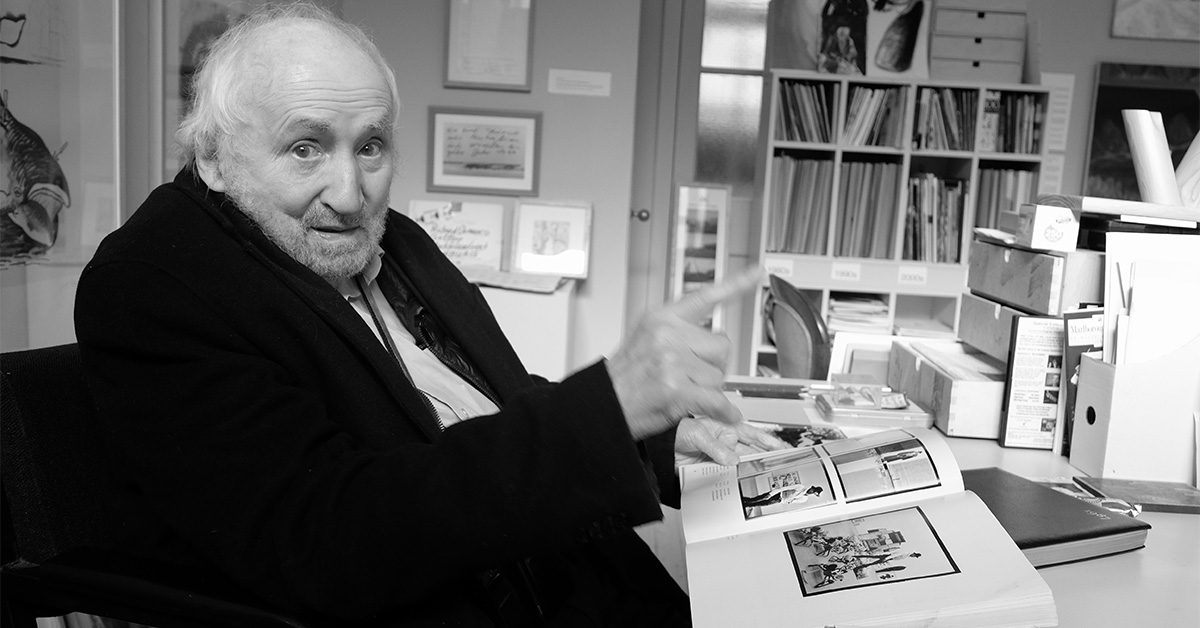
Richard Demarco, long a prominent figure in the Scottish cultural sphere, is well known for his provocative statements, including fierce criticism of Scotland’s cultural institutions and its ‘officialdom’.
In my Scottish Affairs article, I argued that, despite his hyperbolic language and tendency to catastrophise, Demarco’s cultural perspective retains real cogency. I traced the deeper story behind his passion for that vision. At 96, he has a gloomy outlook in many respects, yet he holds on to a profound optimism about what the language of art can achieve. It has done great things before and, in the right conditions, he believes it could do so again.
At the time of writing, the fate of the large archive he had spent decades assembling was still uncertain. He has since found it a permanent and secure home. This vast ‘Gesamtkunstwerk’, a ‘total work of art’ made up of paintings, photographs, documents, posters and ephemera, occupied thirteen rooms at Summerhall for the last decade. The new arrangement brings mixed feelings, though. The archive’s home is not in Scotland but at the Muzeum Sztuki in Łódź, Poland.
Demarco is deeply grateful that the collection will finally be properly cared for, catalogued and digitised. He is about to visit the archive, helping the curators identify particular items, including people who appear in photographs; information that only he can provide. Its departure from Scotland still causes him pain, though, and seems to confirm a long-held sense that he has never truly been accepted. The small boy once bullied for his Italian background has never quite felt that he fitted in. Over the decades, he has fallen out with a number of significant figures and institutions in the Scottish art world. Then again, he has never tried especially hard to fit in. There has always been, it must be said, a streak of self-sabotage in his character.
‘Overwhelmed by Memories’
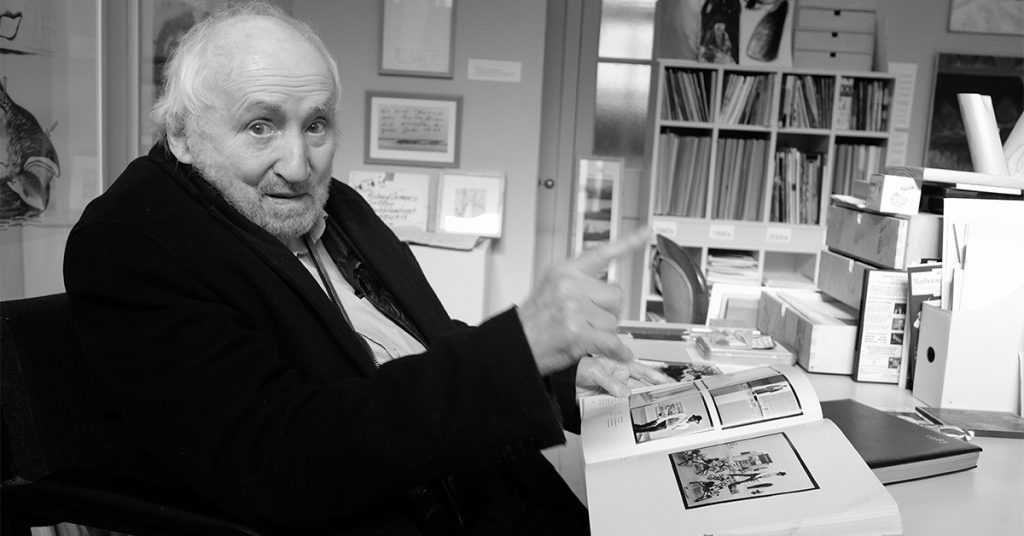
These traits were on display at a recent public event marking the publication of Demarco’s Europe, his third book with the writer and journalist Roddy Martine. There, Demarco admitted to feeling ‘overwhelmed by memories’. Born in 1930, he told the room that ‘practically all my friends are dead’ and that there is ‘no one to speak to’ about the early festivals.
He is among the last people alive to have attended every Edinburgh Festival since 1947, and each month brings fresh losses among his old collaborators. He described himself as a survivor, though he reflects daily on ‘what happens after I die’, a question that has come to shape what happens to his archive.
Those memories are bound up with the Second World War. The Festival, Demarco explained, grew directly out of the conflict, conceived as a way of healing some of its wounds, while ‘the horror of war’ dominated his childhood. This is why 1947 changed him. Edinburgh, a city he had found unwelcoming, became, in his eyes, the ‘European capital of culture’, ‘indeed the world’.
He remains ‘still committed’ to that early vision, an answer of sorts to the question he put to the room: ‘what the hell am I doing at 96?’ The war has not stayed in the past for him, either. He is already thinking about what becomes of his archive should Russia invade Poland. The collection now sits a few hundred miles from the border with Ukraine, and he raised, without flinching, the prospect of the Polish army fighting again for the freedoms it defended during the Second World War.
Living a Lie
‘I’ve had to disguise myself all my life,’ Demarco said, meaning that adopting the English name Richard rather than Riccardo amounted to ‘living a lie’, a betrayal of his Italian heritage that he described with visible sorrow.
What the 1947 Festival revealed to him was his own essential Europeanness, and a wish for ‘nothing to do with the British Empire’. Yet he never felt at home in the country he had settled in. ‘I didn’t fit into the British way of life,’ he said. Edinburgh then had few immigrants, and his Italian, Catholic background, schooled at Holy Cross Academy, marked him out. That sense of marginalisation, he said, ‘hurts him deeply’ still, and Scotland remains, in his words, ‘a difficult country to feel fully European in’.
Scotland, he argues, is ‘dead in the water without a European connection’. He is sceptical of the ‘special relationship’ between the United States and the United Kingdom, insisting that the relationship with Europe matters more: ‘I’m 100% in Europe’.
He put the challenge directly to the audience, asking ‘don’t you want to be the world capital of culture?’, and said he had spent his ‘whole bloody life’ pursuing that ambition for Edinburgh, without success. He had hoped the Festival might rival the Venice Biennale or Documenta. Instead, he argued, it has left no serious ‘imprint’ on the city, a failure he lays partly at the door of an education system that has also pushed the arts to one side — a subject he feels strongly about as a former teacher.
Buried Away
This year has brought Demarco two severe blows: the death of his wife, Anne, and the departure of his archive from Summerhall to Łódź, described in the room as the ‘export’ of the collection. Behind both lies a broader grief: the loss, as Demarco sees it, of the Edinburgh Festival’s founding idea.
He dates the Festival’s genuine existence to roughly its first forty years, from 1947 onwards, and regards the present version as a much thinner iteration by comparison. In an article for the University of Edinburgh Journal (‘The Edinburgh Festival and the University of Edinburgh’, 48:2), Demarco suggested that the Festival’s changing character ‘could be discerned as early as the 30th anniversary year of 1977’, when ‘the increasing power of market forces began to exert an influence’. The debate over the relationship between the Festival and the market is just one of several to which he has contributed.
For Demarco, an increasingly commercial mindset and a shift towards ‘spectacle culture’ have narrowed both the Festival and the Fringe. In his view, the visual arts, which he did so much to establish within the Festival and Fringe during the 1970s, have since been pushed to the margins. His head dropped into his hands more than once as he spoke.
In 1995, Demarco sold a substantial body of material to the National Galleries of Scotland, yet little has been done with it since. Those who acquired the collection have since left the institution, leaving Demarco, on his own account, caught out by a loss of institutional memory. He is blunt about the outcome. Much of the material is ‘buried away’ and out of reach, and for Demarco, work that cannot be reached is ‘no use’ at all. He wants what he has produced to inspire and educate, not sit in storage.
The hope is that it will finally see the light as part of the Artworks project, due to open in Granton in 2028. That collection, he said, now has ‘nothing to do with me’. He has ‘no access to it’ himself, and experiences the whole episode as a kind of exile from his own life’s work. In fairness, though, he did sell this portion of his archive, so his sense of grievance may be overstated.
The gift of his wider archive to the Polish nation stands in sharp contrast. Valued by him at £75 million, although others have put a far more conservative figure on it, the collection was moved out of Summerhall in five lorries and is now in the hands of a team of Polish art historians who, by his account, are treating it properly. Even so, the arrangement underlines his disappointment that Scotland never wanted it.
Alongside the original artwork, large parts of the archive document the Edinburgh Festival and Fringe, much of which exists nowhere else. If made publicly accessible, this material could provide an extraordinary record of the Festival’s history since 1947. The absence of a place in Edinburgh where visitors can go to discover that story remains a significant cultural gap in the city.
Never Found Anyone to Share My Mindset
Demarco measured the present against figures such as Jim Haynes and John Calder, whose vision for the Traverse Theatre burned brightly, if only for a handful of years. He has, he said, ‘never found anyone to share my mindset’, a remark that points towards why lasting institutional partnerships have eluded him, and why he has repeatedly found himself at odds with the art world and with what he calls ‘officialdom’.
Roddy Martine, beside him, struck a different note. He described a 1970s trip to the United States that revealed Demarco’s ‘extraordinary reach’, a name known far beyond Scotland. While that prominence has faded since its peak in the 1970s and 1980s, Demarco has maintained a public profile. Martine’s own break into journalism came through a ‘scoop’ interview with the broadcaster David Frost. Edinburgh, for him, was transformed by the Festival. For three weeks a year, the city stopped being ‘a dark and great place’ and became ‘buzzing’.
Demarco became ‘part of my life’ for Martine back in the 1960s, and the pair were given three months to write Demarco’s Europe in time for the 2024 Festival. It was not, Martine admitted, ‘quite the book we set out to write’, though he believes it uncovered a story worth telling, built around Scotland’s cultural pull on Europe and Europe’s pull on Scotland.
Unlike Demarco, Martine feels the Festival is ‘still going strong’, crediting Demarco with a share of the credit for putting it on the map through the visual arts. He called it ‘a tragedy’ that the archive left Scotland at all, tempered by relief that it is now properly looked after.
A Deep Sense of Loss
Those who came to hear the two men were mostly familiar faces, a loyal and dwindling band of supporters well used to Demarco’s rhetorical habits and ready to forgive his repetitions. He knows this, and the struggle to reach anyone beyond that circle frustrates him. What hope remains rests on the archive and on the artists he has worked with, carrying his cultural vision through the three books written with Martine.
Demarco believes the official International Festival is now drowned out by the Fringe. Only around the Usher Hall, he pointed out, do EIF posters still appear. Everywhere else in the city, the lamp posts and hoardings belong to the Fringe.
He named his condition plainly: ‘suffering from a terrible pain of loss’. He is grieving the people, the lost art and the lost vision of the Festival, while using his own memory in an attempt to revive that original idea.
He recognised the risk in this. His conviction that the visual arts programme of the early Festival outclassed anything on offer today rests on a shrinking group of people able to confirm it firsthand. It could easily be dismissed as nostalgia seen through rose-tinted glasses.
His answer was to stand on the authority of experience itself: ‘my memories are older’ than those of most people in the room, and ‘no one can share my overarching sadness’ at what the Festival has become. In his view, it is a sphere given over largely to entertainment and ‘money-making’.
Wedded to the War
Demarco’s closing point brought his story back to where it began: to the war, and to the Festival as a counterpoint to conflict, ‘a much-needed healing balm’ intended to ‘ease the pain inflicted on humanity in the aftermath of the Second World War’. The history of the Festival, he said, is ‘wedded’ to the war that produced it. Demarco’s Europe is, in part, his own record of that connection, written down while there is still someone alive who can tell the story firsthand. What happens to that record now lies largely beyond his control. It is in Łódź, a hundred miles from a border he watches with something more than a historian’s interest.
About the author